Tuesday, December 30, 2025

Beyond Lies the Wub: The Collected Stories of Philip K. Dick, Volume One (1987)


Dick, Philip K. Beyond Lies the Wub: The Collected Stories of Philip K. Dick. Underwood-Miller, 1987.

Overall:     8/10

The volumes of Philip K. Dick's Collected Stories reprint his short stories and novelettes chronologically as of their time of composition, and Volume One, Beyond Lies the Wub, contains his earliest stories, most published between 1952-53. Since Dick's writing improves with experience, the latter volumes are likely better as a whole, but there are nonetheless a good number of strong stories in here. The ideas are fresh, and many of the themes that are today associated with his work are present in many of the early stories. Alongside them are experiments he abandoned early, thankfully. Such as the character Dr. Rupert Labyrinth and whatever humour Dick tried to infuse in these stories.

Though these are his early works, a few of his better and oft read stories are found here. My favourites are the standards "The Variable Man" and "Paycheck," along with the outright sci-fi horror "The Colony," and the predictable but compelling "The Skull." Really, all the stories are good, with the exception of the little humourous ones. My least favourite is the forgettable "The Short Happy Life of the Oxford Brown."


Stability     7/10
The Collected Stories of Philip K. Dick Volume One: Beyond Lies the Wub, Columbia: Underwood/Miller, 1987.

In a distant future society, Robert Benton is called to see the Controller, who informs him that the invention he has submitted has been rejected, as it threatens the stability of society. Benton is confused, however, since despite confirming that it is his handwriting on the submission forms, he does not recall having submitted any invention.

According to the notes in the book, "Stability" was written around 1947, but was not published until it was included in this first volume of his collected short stories in 1987. In the story, Dick presents us with two visions of authoritarian society. In the first, Benton lives a leisurely life while many others appear to serve government, feeding machines with data cards, attempting to halt progress as it is believed humans have gone as far as they were meant to. In the other, humans are slaves to machines in a more industrial society. Little is given of this world, but we can imagine either a leisure class that benefits from what is essentially human slavery, or a world entirely controlled by machines.

Dick does not give preference to either of these worlds, presenting two dystopic visions of humanity. Though famously known for abhorring extreme forms of government, and there is much in the first society to indicate the utter control which government holds, he also wrote much about humanity's subservience to machines and technology. In both these worlds humans, or at least some classes of humans, are subservient to machines, but in the former world, protagonist Benton does live a comfortable life and appears capable of free thought, if not free action, whereas in the latter he appears entirely brainwashed.


Roog     7/10
The Magazine of Fantasy and Science Fiction, February 1953.

The world seen through the eyes of a loyal dog, who tries to guard the valuable trash bin from the invading garbage collectors. Amusing and kind of sweet.

According to the notes section from The Collected Works of PKD Volume 1, "Roog" was Dick's first sale, though not his first publication. Those same notes, written by Dick himself, indicate that it was among his personal favourite stories.


The Little Movement     7/10
The Magazine of Fantasy and Science Fiction, November 1952.

A vendor manages to sell a wind-up toy soldier to a passing boy and his father. At the house, the toy soldier immediately puts his plan into motion: to conquer the world by controlling children. It turns out a number of sentient toys have been unleashed on the world seeking dominion, but many have been lost or destroyed, and the little soldier tries to rally the remaining toys in order to execute their goal.


Beyond Lies the Wub     7/10
Planet Stories, July 1952.

During a re-supply stop at a space station, crewman Peterson purchases a porcine alien known as a wub. He is ridiculed for the purchase, and Captain Franco, who is displeased with the extra weight aboard and the ship's food shortage, wants the wub served up for dinner. But the wub proves to be an intelligent, talkative creature, who quickly befriends Peterson and grows to be liked by the crew. Captain Franco, however, fears the animal, and orders it to be cooked.

A highly enjoyable story with a great ending. I've re-read this story a few times and it continues to delight. I believe this was the first Dick I read, from the anthology First Voyages, edited by  Martin H. Greenberg, Damon Knight and Joseph D. Olander, Avon, 1981.


The Gun     7/10
The Magazine of Fantasy and Science Fiction, February 1953.

In the hope of encountering intelligent life, a ship seeks the source of a distant bright light. However, when they reach the planet from which the light emanated, they are shot down. They soon discover that the inhabitants of the planet have annihilated one another, and a gun was erected over a tomb which contains the relics of their civilization. The crew stranded on the planet need to discover a way to leave the planet without again getting shot down.

A powerful anti-war piece, one of many written by Dick.


The Skull     8/10
The Magazine of Fantasy and Science Fiction, February 1953.

In the distant future, prisoner Congden is sent back in time to kill the founder of the First Church, a group that is believed to have altered the course of civilization for the worse. He is handed the founder's skull as a tool to help recognize the man.

An excellent time travel story that holds up well, despite an obvious ending.


The Defenders     6/10
Galaxy Science Fiction, January 1953.

Well into a nuclear war, humans have moved underground where they have constructed a new civilization, yet their machines of war continue to battle on the planet surface. Don Taylor is called away from his Rest Period and brought to First Level, just below the surface, where he is shown a recent discovery. A surface robot, or "leady," was brought down and appeared to be entirely free of radiation. This is the second leady to have recently been found with no traces of radiation, and after eight years living underground, the military believes it is time to send a party of men to the surface to investigate.

A good concept, more idealistic and less defeatist than much of Dick's other work. The enemy again is Russia, as the story links the move underground to the latter stages of the Cold War. Elements of this story were used in his 1964 novel, The Penultimate Truth.


Mr. Spaceship     6/10
Imagination, January 1953.

In an ongoing battle against a race near Alpha Proxima, humans are at a standstill as they cannot breach the defenses set up by thinking mines. So in order to fight against intelligent weapons, the humans develop an experimental ship controlled by a disembodied human mind.

A slow start, the story does manage to become quite interesting as it plods along. I can only imagine how great some of these earlier stories would have been had a good editor been available to help remove some of the  awkward clunkiness in Dick's writing. Yet given his financial situation throughout his life, Dick was always in a hurry to publish.


Piper in the Woods     6/10
Imagination, February 1953.

A soldier at an asteroid garrison returns believing he is a plant. A psychologist begins to investigate the belief, as more people stationed at the asteroid become infected with the same belief.

Published one month after "Mr. Spaceship" in the same publication, this one replaces the clunkiness of its predecessor with much charm.


The Infinites     6/10
The Magazine of Fantasy and Science Fiction, February 1953.

Near the end of their mission scouting for asteroids, a three-person crew lands on an odd piece of rock to investigate, but are struck by intense radiation. On their way back to Earth, they begin quickly to transform physically, then mentally.

An interesting idea, though not entirely new, on rapid evolution. Some poor characterization and awkward writing and dialogue unfortunately drag this story down. Particularly the 1950s depiction of a distant future where women continue to be characterized and emphasized by their appearance. The single female in this story, though a competent scientist, loses her competency when she loses her hair.


The Preserving Machine     6/10
The Magazine of Fantasy and Science Fiction, February 1953.

The first Dr. Rupert Labyrinth story, in which he creates a machine to help preserve music after suffering a nightmare where music is destroyed during wartime. The music, however, is stored in some unique living creatures. The creatures are neat and Dick's play with creating creatures that capture the essence of popular composers is the best part of the story.


Expendable     5/10
The Magazine of Fantasy and Science Fiction, July 1953.

A man displays intense paranoia when he believes he can listen in on the conversations of insects. Another interesting idea with much potential for horror, particularly the build-up near the end, which is lessened by some weak writing and a last line that I found to be just awkward.


The Variable Man     7/10
Space Science Fiction, September 1953.

In the year 2136, at the culmination of a century-long war between Earth and Proxima Centauri, humans wait for their machines to send predictions of who would win the war. As the prediction begins to favour Terra, and they prepare to launch a major assault, a man is brought back from 1912, and the machines can no longer give their predictions. This is the variable man. 


The Indefatigable Frog     7/10
Fantastic Story Magazine, July 1953.

A pair of college professors, Hardy and Grote, argue over Zeno's paradox of the frog and the well. This paradox proposes that a frog tries to hop out of a well, but each of its jumps is half the previous one, so  will he be able to reach the top of the well? Prof. Hardy lectures that a small margin will always remain and the frog will never reach the top of the well, whereas Prof. Grote insists that even with each jump being reduced by half its length, it would eventually make its way to the top. To settle the argument, the two create an experiment using a frog and a tube, and shrink the frog's size to half with each jump.

An interesting concept and a good story.


The Crystal Crypt     7/10
Planet Stories, January 1954.

Structured as a triptych, with the first third presenting the Martians questioning the passengers of a stalled ship to find their perpetrators, the second being the story of the trio who allegedly destroy the city, and the third being the brief denouement. My favourite is the first, as it is genuinely suspenseful and Dick does a good job at set-up. The finale is expected, because there really only is one way the story, as it is presented, can end.


The Short Happy Life of the Brown Oxford     5/10
The Magazine of Fantasy and Science Fiction, January 1954.

Dr. Rupert Labyrinth has built an agitator, a machine that makes inanimate objects come to life. Believing he has failed, he gives the machine to the narrator, who stores a pair of wet shoes in the machine overnight. Lo and Behold! the shoes come to life. The story is more of a joke, missing the interesting elements of the previous Dr. Labyrinth tale that made that one, at least, a little interesting. This one is, sadly, just plain bad.


The Builder     7/10
Amazing Stories, December 1953-January 1954.

An average suburban man is obsessed with building a boat in his yard, to the ridicule of his neighbours and the detriment to his marriage; even his older son mocks him. The story focuses on his obsession and mounting self-doubt.


Meddler     7/10
Future Science Fiction, October 1954.

An expert in history is brought into a secret government mission. A "digger" was sent into the future to take images in order to evaluate current government policy, and while the photos indicated prosperity for the future, soon the images changed to war and seemingly annihilation. The belief is that sending the digger to the future is what brought this on, and the historian is sent forward to investigate the root cause.

Highly suspenseful and again a wonderful idea from Dick. Yet again the ending is predictable, but this form of time travel ending (I won't spoil it) has become familiar to contemporary readers. It may have been familiar in the 1950s as well, since it was only first reprinted in Dick's 1980 collection, The Golden Man (Berkley).


Paycheck     8/10
Imagination, June 1953.

Following a two-year involvement in a secret corporate venture, Jennings awakens with no memory of those two years. This was pre-arranged between himself and his employer, all for a hefty paycheck. Yet Jennings trades in his pay for a bag of trinkets he had prepared for himself a few days prior to awakening, and with the aid of these items, he begins to piece together the events of the last two years.

An excellent concept and a great story. The piecing together seems a little too easy, though, but I guess for length it had to be simplified. With more complex plotting and wider world building, "Paycheck" could have been a novel. However, the ending, as is, works with a short piece, as it would be a let-down in book-length.

Avoid that awful John Woo adaptation.


The Great C     7/10
Cosmos Science Fiction and Fantasy Magazine, September 1953.

The Great C is a super-computer that many generations ago grew too powerful, and wreaked nuclear wreckage on humanity, an event known as the "Smash." Since the Smash, a tribe of surviving humans must each year send one of its members to the Great C to ask it three questions. If the computer is  able to answer the questions, the tribe member will be sacrificed, whereas if it is unable to answer, it will free humanity.

A strong story, with added weight in the age of AI.


Out in the Garden     7/10
Fantasy Fiction, August 1953.

Robert Nye complains to his friend Lindquist that his wife Peggy is always in the yard with Sir Francis, her pet duck. Lindquist is reminded of Yeats's poem "Leda and the Swan," which recounts the story of Zeus impregnating Leda while in the form of a swan. When Peggy gives birth to a boy, Robert begins to question if the child is his.

A good story with a great, horrible ending.


The King of the Elves     6/10
Beyond Fantasy Fiction, September 1953.

Gas station owner Shadrach Jones is visited by elves. It appears their kind has died in the old man's bed, and has commanded his subjects to make Jones their new king.

Among the weaker stories of the bunch.


Colony     8/10
Galaxy Science Fiction, June 1953.

An exploration team on the "Blue Planet" believe they have discovered paradise. However, when Major Lawrence Hall's microscope tries to strangle him and other items begin attacking the crew, they learn that this perfectly safe planet houses the most dangerous life form, one that can perfectly imitate any inanimate object.

Among my favourite stories of the collection. A great example of science-fiction horror, as well as Dick's fascination with paranoia.


Prize Ship     7/10
Thrilling Wonder Stories, Winter 1954.

Centuries in the future, inhabitants of the nine planets use "cradles" to warp to outer colonies. Aliens from Ganymede have hijacked the cradles and threaten to destroy them if the solar system alliance refuses to pay them a tax for every shipment sent out. On the cusp of giving in to the Ganys, the alliance manages to capture an experimental Gany ship, and tries to use it to get to the outer colonies. Only it is an odd vessel, and the first flight takes them to a strange world.

The build-up and complication of the plot are more complex than the denouement deserves, since the details of the alliance and the Gany's and their technology is pushed aside as focus in the latter part of the story is primarily on the strange world and a bit of PKD humour.


Nanny     7/10
Startling Stories, Spring 1955.

Tom and Mary Fields rely heavily on their robotic nanny. Nanny, though, is an older model, and gets into a scuffle with a newer model that leaves her in need of repairs. It seems it is common for robot nannies to get into scuffles, with the newer models destroying the older ones, while the industry profits, as they encourage consumers to purchase the newer ones rather than repair the damaged nannies.

There isn't much by way of story here, but the idea is excellent, and while Mr. Fields figures out the consumer aspect of the racket, he is nonetheless driven emotionally to purchase something he can barely afford, and is essentially part of a pattern, or even a pandemic or consumerism.


For more of this week's Wednesday short stories, please visit Patti Abbott's blog.

Tuesday, November 25, 2025

Roald Dahl, Skin and Other Stories


Dahl, Roald. Skin and Other Stories. Puffin/Penguin, 2000.

Skin and Other Stories at ISFdb
Skin and Other Stories at Goodreads


Overall rating:     6/10


Of the eleven stories in this collection, I had already read six, though none of them recently. The collection is a little uneven, as it includes stories from different aspects of Dahl's oeuvre: his short suspense and twisty stories, along with a couple of the early WWII tales and a pair of novelettes, which I really could have done without. Dahl's adult short stories are hit-and-miss, as is this collection.


Skin     8/10
The New Yorker, 17 May 1952

Tattoo artist Drioli, now an old man, notices a painting in a shop window on the rue de Rivoli, and recognizes the artist as a friend from before the war. He had met fellow Russian countryman Chaïm Soutine by chance in a bar, and the two hit it off, soon living together along with Drioli's wife. Soutine was a painter and Drioli a tattoo artist, and one drunken evening Soutine painted an image of Drioli's wife onto Drioli's back, which he then tattooed. Now, poor and miserable, Drioli discovers that there is a large fortune on the skin of his back.

At first I was mixed about this story, as I sometimes am with stories that hinge too much on their twist ending. I was immersed in the pre-wartime narrative of this trio of struggling, drinking immigrant artists, that the ending initially came off as disappointing in light of their relationship. A few days of reflection, I decided that the ending in this case enhances certain aspects of the characters and their relationships, and is arguably the darkest ending of Dahl's shorter works.


Lamb to the Slaughter     8/10
Harper's Magazine, September 1953

A very pregnant and very smitten Mary Maloney waits for her husband, Officer Patrick Maloney, to come home after work. It is Thursday night, the night they normally go out for dinner, so she hasn't prepared anything. But when Officer Maloney does come home, it is clear something is wrong, and she suggests they stay in and she will defrost some meat to prepare for dinner. Maloney finally tells her that he is leaving her for another woman. Mary is in shock, not fully comprehending, and takes a leg of lamb from the freezer, which, without premeditation, she uses to knock him dead.

A wonderful story, economically written. It is our concern for Mary that drives the narrative, and Dahl succeeds in creating a victim out of a murderer. The story is enhanced by its wonderful and faithful adaptation (adapted faithfully by Dahl himself) for Alfred Hitchcock Presents, directed by the Master of Suspense himself. It is difficult to read the story, though I've read it a few times, without seeing the wonderful Barbara Bel Geddes as Mary Maloney.


The Sound Machine     7/10
The New Yorker, 17 September 1949

Klausner has invented a machine that can pick up vibrations--sounds--at pitches far beyond what the human ear can hear. Though secretive by nature, Klausner reveals the nature of his invention to his doctor, who happened to walk by as he was working on it. The machine finally ready, Klausner soon learns that the cutting of flowers and other living organisms appears to cause a terrible reaction from the source.

An enjoyable story whose ending is focused more on the effect of the machine on its inventor, rather than some kind of twist.


An African Story     6/10
Over to You: Ten Stories of Flyers and Flying, Reynal & Hitchcock, 1946

In the highlands of Kenya, an old man living isolated and alone tells the tale of his once neighbour Judson, who killed his dog, and the patient vengeance he eventually set up for the man. Well written and captures the mood and the isolation of the Kenyan plains, the last portion is expected and as a result some of the charm wears off.

The story is framed by an RAF pilot who encountered the man when his plane went down. The old man, glad for company, recounted the tale with claims he'd never told anyone. The pilot write it down as soon as he returned home, and kept it to himself until a fellow airman found it following his death. A bit of a build-up for the story, likely to fit into the collection in which it first appeared, but not too necessary for the story if it appears by itself. It would be better to let the Kenyan narrate the tale and not through the interpretation of the white, European pilot.


Galloping Foxley     6/10
Town & Country, November 1953

Perkins is a sixty-three year-old man of routine, who particularly enjoys his daily commute to work. Until one day, when a stranger appears on the platform of the train station, instilling unease in the usual travellers. When getting on the train, the stranger steps into Perkins's compartment and sits facing him. At first appalled, Perkins soon recognizes the stranger to be Bruce "Galloping" Foxley, who at their private boarding school, mercilessly bullied the younger Perkins.

Much of the story focuses on details of the bullying. My favourite section is the opening, preceding the memories, with Perkins describing the pleasure he gets from his commute, and the discomfort generated by the stranger who appears on the platform, disrupting his routine. The bullying sequence is overlong, and the twist in this one sort of negates the emotions that arose, as it aims more at the comical than the dramatic.


The Wish     7/10
uncertain original publication data, 1948

A young boy decides to walk along the extended hallway to the front door, stepping only on the yellow parts of the carpet. Make believe begins to blur reality and imagination, and a nice ambiguous ending makes the reader wonder what really happened. A nice, brief story, made interesting by its capture of childhood fun, and its ambiguous finish. Felt reminiscent of Bradbury's stories, probably in the treatment of childhood games.

Unfortunately, I can't find the original publication information for "The Wish." Many sources indicate the year as 1948, but then go onto mention its publication in Someone Like You, which first appeared in 1953. Chat GPT was unable to help me with this, but confirmed 1948 as the year based on "several sources." (Probably the same sources I looked at.)


The Surgeon     5/10
Playboy, January 1988

Dr. Robert Sandy has saved the life of a Saudi Arabian prince, and the prince offers him a gift of large, white diamond. He visits a jeweler and learns the diamond can be worth one million on the market, then heads home to share the news with his wife. They are about to drive off for the weekend, and wonder where they could hide the diamond to ensure its safety.

The shortest story in the collection is followed by the longest. "The Surgeon" is overlong, and reads as though Dahl needed to reach a minimum word count, since there are so many unnecessary details bogging down what is really a simple story. Had it been the length of "Lamb to the Slaughter," it might be ok, but the story hinges on one single idea, the clever hiding of the diamond, and what follows is just not that interesting. It is not helped that the uninteresting latter part of the story is long, and the ending is outright flat. To add to this, probably because the story appeared originally in Playboy, the (very mild) cursing in the story is awkward, as it is forced.


Dip in the Pool     7/10
The New Yorker, 19 January 1952

During a cruise, passenger William Botibol aims to win the daily pool in which bets are made as to how much distance the ship will make the following twenty-four hours. Since the ship entered a storm, Botibol bets low, but awakens in the morning to calm weather and a speeding ship. Desperate to win the six thousand dollar pool, he plans a risky maneuver to slow the ship down.

I first read this as a kid and it remains an enjoyable story. As with Dahl's most interesting work, it is short and focused on its trickery. I found the betting process more interesting than Botibol's plans and the story's climax.


The Champion of the World     5/10
The New Yorker, 31 January 1959

Two filling station employees plan to poach the pheasants on the land of the local arrogant wealthy brewer. Another overlong story, this one is more of a comedic story for younger readers, and is not terribly funny nor very interesting. Perhaps in 1959 it would've raised a couple of chuckles.


Beware of the Dog     7/10
Harper's Magazine, October 1944

A World War II British fighter pilot is flying home, disoriented as he has lost his right leg. Feeling he will lose consciousness, he bails from the plane, and later awakens in a hospital room. Halfway down his right leg is a stump, and though he is taken well care of by a nurse and doctor, he continues to feel disoriented, and cannot bury the feeling that something is just not right.

A genuinely suspenseful story, well written, nicely fusing Dahl's wartime writing with his suspense story writing.


My Lady Love, My Dove     6/10
The New Yorker, 21 June 1952

Arthur and his wife Pamela have invited the Snapes over for the weekend for bridge. While Pamela does not particularly like the Henry and Sally Snape, they play a good game so she is happy to have them. As the pair discuss the weekend the morning before their guests' arrival, domineering Pamela thinks it would be a good idea for Arthur to place a microphone in the gust bedroom, and in the evening eavesdrop on their private conversation.

An entertaining story that unfortunately falls flat. I understand what Dahl is doing in terms of characterizing Pamela and the couple's dynamic, but the focus of the buildup is pretty much discarded for the joke.

Tuesday, September 23, 2025

Casual Shorts: Give Me Your Cold Hand by John Keefauver


Keefauver, John. "Give Me Your Cold Hand." The Sixth Pan Book of Horror Stories, edited by Herbert van Thal, London: Pan Books, 1965.

Rating:     7/10


While frantically helping to dig a man out from a collapsed tunnel on Carmel Beach, south of San Francisco, Tony notices a female bystander intently watching the scene. The woman has a noticeable presence: she is tall and powerful--sexually powerful--and Tony quickly falls for her. In turn, Anita is drawn to Tony, admiring his large, strong hands. She is drawn to men with large hands, but as her husband hit her with his before abandoning her altogether, to protect herself she carries a sharp darning needle in her clothing.

Tony and Anita's relationship progresses quickly, and he moves into her and her husband's million dollar home on Pebble Beach. Yet shortly after moving in, Tony becomes annoyed at her obsessive need to keep the needle on her person. In fact, he is creeped out by not only Anita, but by groundskeeper George, who believes Mr. Nelson, Anita's husband, communicates with him. Tony's aggression and Anita's passion clash, and their relationship quickly begins to sour.

This story is surprisingly suspenseful, and has a plot more layered than most of the standard stories that appear in the Pan Books of Horror Stories. Of his six stories to appear in the Pan anthologies (four originals, one reprint and one re-write), this one is my favourite.

The structure here is a little different as well. A good opening scene takes place following the events of the story, describing a group of cops digging in the rain, and beside the hole is a covered corpse. Meanwhile narrator Tony and groundskeeper George sit and watch, handcuffed together. Some clues mixed in with some misdirection.

This story was (much) later re-written as "Dead Voices Live" for the 1992 Joe Landsdale-edited anthology Dark at Heart. It would be interesting to know what led to the decision to re-write an early story.

For more Wednesday Short Stories, please visit Patti Abbott's blog.


Tuesday, September 2, 2025

Invasion of the Robots, edited by Roger Elwood (1965)


Elwood, Roger, ed. Invasion of the Robots. Coronet, April 1965.

Invasion of the Robots at the ISFdb
Invasion of the Robots at Goodreads

Overall rating:     6/10

Paperback Library,
April 1965
This collection edited by busy editor later-turned-author Roger Elwood features short stories containing robots (though in modern terms many of these machines are androids). While the use of "invasion" in the title might imply evil robots, the inclusion of the name Asimov on the contents page reveals that the invading robots can serve a good purpose, therefore the "invasion" is more appropriately an introduction, or an insertion into human life. The stories span a decade (or just a few months over), from December 1942 to August 1953. Overall the stories are fairly average. Most were new to me, including the much respected Jack Williamson story "With Folded Hands..." (easily the darkest of the bunch). The other two I really enjoyed were Richard Matheson's "Brother to the Machine," despite its obvious twist, and Robert Bloch's "Almost Human," which was a re-read but still highly enjoyable as many of Bloch's tales are.

The other stories were just alright, including Philip K. Dick's "The Defenders" (also a re-read), which is great until that last post-reveal act. Eric Frank Russell's "Boomerang" (formerly "A Great Deal of Power") is downright bad.


Satisfaction Guaranteed by Isaac Asimov     6/10
Amazing Stories, April 1951

Dr, Susan Calvin leaves a robot in the care of a housewife, as part of an experiment to integrate industrial robots into the home. Housewife Claire is married to ambitious Engineer Larry Belmont, who wants his wife to be a great hostess, but mousy Claire was never up to the task. Yet with the help of robot TN-3, or Tony, she can transform their home into a proper socialite party house.

Because of course that's what every modern woman strives for. A hyper intelligent robot at your disposal, you set your goal to ultimate housework. For modern readers the sympathy toward Claire and the hint of her ability to transcend her life feels wasted, though Dr. Calvin has a nice last line at the expense of Larry Belmont. Despite this, the story is amusing.


Piggy Bank by Henry Kuttner and C. L. Moore     6/10
Astounding Science-Fiction, December 1942

"Ballard's diamonds were being stolen as fast as he could make new ones."

Lazy Gunther has discovered a patent which he was able to tweak and use this invention to make diamonds. Bruce Ballard is the diamond seller who bought the recipe. Yet Ballard's diamonds are being stolen, and as they have a symbiotic relationship in which one does not tell on the other, Ballard expects the lazy, yet highly intelligent, Gunther to build him an impenetrable safe. Instead of an uncrackable safe, Guenther develops a robot safe that, like an animal, can flee at the sound of danger.

An interesting premise and a good opening, but the story spends way too much time coming up with ways of trying to catch the robot, and failing of course, with much running and jumping around.

Oddly, the anthology credits the story only to Henry Kuttner.


With Folded Hands... by Jack Williamson     9/10
Astounding Science Fiction, July 1947

Underhill sells mechanicals, but it's a challenging market in this day and age, with fierce competition amid a market saturated with all forms of robots and androids. Lost in thought, Underhill walks into a building, and notices a new android shop where he is certain no building stood a week ago. He enters the shop and soon realizes his business will suffer even more, as the androids on display are sleek and highly advanced. And when he realizes the sales attendant is also an android he is shocked, but not as shocked as when the android tells him that he will soon be out of business.

What a lovely, creepy opening sequence. And a lovely, creepy novelette.

With the help of a seemingly crazed old man who his wife has taken in as a lodger, Underhill joins a fight to rid the world of the androids. An excellent, dark story, and highly relevant in where technology is taking us. A must read.


Brother to the Machine by Richard Matheson     7/10
If, November 1952

In a dystopian, post-war world shared between man and machine, a man is on the move, fearful that the control police are pursuing him. Sure the story is obvious to contemporary readers, but in 1952 it must've had an impact.


The Defenders by Philip K. Dick     6/10
Galaxy Science Fiction, January 1953

During a nuclear war, humanity has moved underground while robots battle the radiation-filled surface of Earth. Don Taylor is just beginning his vacation when he receives a call from his superiors, asking him to visit the near-surface level immediately.

I don't really buy the idea that man, in the story, has progressed beyond hatred and the need for war. Particularly since in the opening Taylor is glad to read the reports of Russian casualties. I also don't buy that man is united, after only eight years of war, in a unified culture, considering that during that period man was utterly divided among their own kind in underground societies. The fatigue and disinterest that the robots report in man, that have replaced their hatred, would more likely add to that hatred, as they are forced to endure such misery as a result of war.

Some bleakness, sure, but surprisingly optimistic for a PKD story. The story's first two-thirds is quite strong, but that lest sequence is quite silly.


Paperback Library,
March 1969
Almost Human by Robert Bloch     7/10
Fantastic Adventures, June 1943

Sadistic criminal Duke discovers that naive scientist Professor Blasserman has built a robot. With the help of his lover, who is Blasserman's nurse, Lola Wilson, Duke moves in with the old man and takes charge of the robot's education. The robot, Junior, has a partially organic brain and is able to learn and evolve, and Duke's education is a form of brainwashing, teaching Junior the benefits of crime and the notion of hatred, which he aims toward the kindly professor.

A wonderful, darkly comedic story with a great Blochian twist. There are some surprising moments of violence, enhancing the cruelty of Duke's outlook on life, and the good people and the bad people all end up with terrible fates. This was a re-read for me, after many years, but I feel I enjoyed it more this time around.

The story was adapted for both popular science fiction radio programs, Dimension X (1950) and X Minus One (1955).


Into Thy Hands by Lester del Rey     6/10
Astounding Science Fiction, August 1945

Long after a nuclear holocaust, a robot awakens and believes his purpose is to recreate human life. He watches a video on creationism, and with his limited understanding of symbolism, sets out to achieve this goal.

Interesting in parts, but not as a whole. The story placed third at the retro Hugo for 1946 (awarded in 1996).


Boomerang by Eric Frank Russell     4/10
As "A Great Deal of Power," Fantastic Universe, August/September 1953

A pair of scientists have built an android programmed to assassinate people who hold a large amount of power. As part of its military testing, the android "William Smith" is sent out to assassinate five men in power.

An interesting concept but poorly written, with stiff dialogue and repetitive sequences. And a predictable finish. The bulk of the story is made up of the android visiting each of these five and assassinating them, which gets tiresome quickly.

For more of this week's Wednesday's Short Stories, please visit Patti Abbott's blog.

Tuesday, July 1, 2025

Casual Shorts: John Keefauver, Kali


Keefauver, John. "Kali." The Fifth Pan Book of Horror Stories, edited by Herbert van Thal. London: Pan Books, 1964.
______. Oriental Tales of Terror, edited by J. J. Strating. London: Fontana, 1971.
______. Research Into Marginal Living: The Selected Stories of John D. Keefauver, edited by Scott Nicolay. Lethe Press, 2021.


Rating:     7/10


This review of "Kali" appears as part of my serial review of John Keefauver's first collection, Research Into Marginal Living.


An American high school teacher visiting Calcutta (now Kolkata), is sidetracked in front of the tourist office by a beautiful local woman. Our narrator is aware that this beautiful Indian woman is obviously not an official tour guide, but quickly he falls for her and allows her to lead him like sheep to see the sites of the city. The woman in turn is obsessed with the goddess Kali, and has taken on the goddess's name. Her personalized tour leads our narrator to a statue of the many-armed Kali, and, as promised, to witness the sacrificing of a lamb. This last experience traumatizes the American, and he returns home quite disturbed.

On the surface, "Kali" is a fairly standard story, one that was likely aimed directly at the Pan Book of Horror Stories series, as it features so many of the series elements. As he did with his homages "The Daring Old Maid on the Flying Trapeze" and "Oh Well What the Hell," Keefauver proves himself to be a master emulator, delivering a story perfectly geared for its intended target. The story contains several standard tropes, and it is evident Keefauver is aware of these tropes as he toys with them. There is a beautiful, foreign woman who everyone appears to fear but with whom the protagonist becomes obsessed. We are to expect that this woman is involved in black magic, or some form of mystical art, but it turns out she is simply mad, leading her to seduce gullible American tourists to feed her fantasy of being Kali.

Below the surface, however, there is an intriguing study of the dark obsessiveness of the narrator, rather than the straightforward, campy obsessiveness of the exotic woman. Early in the narrative, the teacher mentions he is curious about goat sacrifices, and while in Calcutta hopes to see one. Meeting the unregistered tour guide only serves to elevate this desire that he has long been harbouring. We can speculate that it is not the woman to whom he feels drawn, but rather toward the hopes of witnessing the sacrifice. And as expected in such a story, the protagonist gets more than what he hoped. But what is different here is that the narrator is not a victim and the woman not an actual witchy predator, as these women at the time were often presented. The woman is not at fault in driving him to his bloody, obsessive behaviour once he is again on American soil. The seed was already in him, as made clear in the beginning, and the woman is merely a trigger. Had it not been she, he would have been led by someone else to a sacrifice that would in turn have led him to committing his bloody acts. The woman certainly noticed the depraved desire in this man, and latched onto it, but not in the hopes of corrupting him, but simply in order to share her own depraved desires with an equal. Sure she drugs him, but he is an east target, allowing himself to be drugged, and once the deed is done, she simply allows him to leave, meaning no harm. It can also be argued that some other life event could have woken his killing nature, and he was actively in search to allow the nature to be released. Hence a vacation by himself in Calcutta, not the safest of cities for an outsider.

In brief, the woman is not the horrible seducer we expect in these tales, but the narrator is a man seeking to release his dark self. Likening him to the goat, as he is easily led by others, his unrelenting desire to sacrifice goats at the end of this experience can be likened to a sacrificing of his self, an act of self-hatred and not merely a bloodlust.

While "Kali" has some interesting points, and clearly offers food for thought, it is not among Keefauver's strongest stories. It is, however, well written, as his descriptions of the guide, the delivery of the narrator's voice, and the overall pacing of the story, are all quite strong. His stories aimed at the Pan series, emulating the Pan style, show his strengths at adhering to convention, and also at generating suspense and guiding his readers as well as Kali guides her tourists. They do not compare to the stories that would later become his own unique staple, but for what are, these stories are elevated by Keefauver's skill.

Tuesday, June 24, 2025

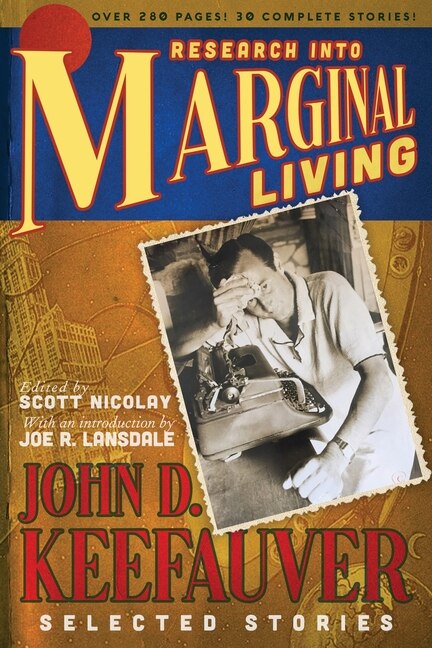
John Keefauver, Research into Marginal Living


Keefauver, John D. Research into Marginal Living: The Selected Stories of John D. Keefauver. Edited by Scott Nicolay. Lethe Press, 2021.


Research into Marginal Living at the ISFdb
Research into Marginal Living at Goodreads

Overall Rating:     TBD/10


A dozen years ago (in 2013), I pleaded for the publication of a collection of stories by John Keefauver. Like many, I'd read a handful of his stories in various anthologies, and quickly realized that there are enough gems in the writer's oeuvre to produce even a slim collection. In August 2017, I received an email from author/editor Scott Nicolay, informing me that he was working with Mr. Keefauver's estate to bring his novel Tormented Virgin back in print the following year, along with a collection of his stories. Exciting news, but I did not receive a follow-up, and as I was busy with a one year-old daughter, I pretty much forgot about it.

Then in October 2021, someone posted on my review of Keefauver's "The Tree" that Nicolay was preparing a collection that should be out in early 2022. A quick search indicated that the book had been released the previous month.

In September 2021, Lethe Press released the first, long overdue, collection of stories by John Keefauver, titled Research into Marginal Living: The Selected Stories of John D. Keefauver. Few books have gotten me this excited, and of course I (eventually) ordered a copy.

I am only partway through, but decided to begin posting reviews of the stories as I read. So far the collection is excellent. Not only does it contain thirty short stories (selected from the allegedly 796 that he published during his lifetime), it has two very good introductions (one by Nicolay and another Joe Lansdale, who had included a couple of Keefauver's stories in his anthologies). In addition, Nicolay provides notes following each story that includes fascinating details about the stories and about Keefauver, hinting at the story-selling process over a handful of decades.

This collection is highly recommended, and you can purchase a copy at the Lethe Press website, where it is currently on sale for a mere $15! Please go support the project.


Oh Well What the Hell     7/10
Playboy, November 1958

A surprisingly enjoyable poem based on Lawrence Ferlinghetti's "A Coney Island of the Mind." Keefauver penned this homage months (or weeks) after the publication of Ferlinghetti's book. Throughout his career Keefauver would write other homages and parodies, showing a penchant for literary mimicry. We will see other kinds of mimicry in the collection, with stories produced for the Pan Horror Stories series, and with stories touching on a vast variety of styles. The best stories, though, are the ones he developed himself, lending his own Keefauverian touch.


The Daring Old Maid on the Flying Trapeze     7/10
Big Table #2, Summer 1959

This story emulates the work of the popular Beat writers of the time. The story follows the final hours of a former trapeze artist as she struggles down on her luck. While I am not an admirer of the Beat style, this story snuck up on me and surprised me with its bittersweet narrative. The title reflects the William Saroyan 1934 short story, "The Daring Young Man on the Flying Trapeze."


Kali     7/10
The Fifth Pan Book of Horror Stories, Herbert van Thal, ed., London: Pan, 1964

An American high school teacher visiting Calcutta becomes obsessed with a beautiful local guide. The woman, clearly not an official city guide, calls herself Kali, after the goddess with whom she is obsessed. She promises to take the gullible American to witness the sacrificing of a goat. My full review can be found here.


Give Me Your Cold Hand     7/10
The Sixth Pan Book of Horror Stories, Herbert van Thal, ed., London: Pan, 1965

While frantically helping to dig a man out from a collapsed tunnel on Carmel Beach, south of San Francisco, Tony notices a female bystander intently watching the scene. The woman has a noticeable presence: she is tall and powerful--sexually powerful--and Tony quickly falls for her. In turn, Anita is drawn to Tony, admiring his large, strong hands. She is drawn to men with large hands, but as her husband hit her with his before abandoning her altogether, to protect herself she carries a sharp darning needle in her clothing.

My favourite Keefauver story to appear in the Pan Books of Horror series.


The Last Experiment     7/10
Climax: Exciting Stories for Men, November 1960, Vol. 7, No. 2 (pp. 20-23)
The Seventh Pan Book of Horror Stories, Herbert van Thal, ed., London: Pan, 1966

A young US army private agrees to participate in a military sensory experiment.

... coming soon ...


Tuesday, May 13, 2025

Harlan Ellison, Paingod and Other Delusions

Ellison, Harlan. Paingod and Other Delusions. Pyramid Books, December 1965.
_____, Paingod and Other Delusions. Pyramid Books, March 1975.


Overall Rating:     6/10


Pyramid, 1975 re-issue
In 1975, a decade after its initial publication, Paingod and Other Delusions received a new edition by Pyramid Books, with a new introduction by Ellison. This new introduction, titled "New Introduction: Your Basic Crown of Thorns," is one of the strongest pieces of writing in the book. In fact, the power in the introduction comes mostly from a letter written not by Ellison, but to Ellison by a healthcare worker. Great letter, as long as you can look away from all the unabashed self-aggrandizing by Ellison that accompanies it.

In fact, there is much self-aggrandizing in this book, tucked into some of the mini intros he provides for each story. This is unfortunate as it makes it difficult to take the writing--and the author--seriously. This self-referencing style does not, however, come across as arrogant, not in the way that Ellison often comes across as arrogant, but more as though he were unsure of himself, insecure. It is an early collection, and it is possible that revisiting these earlier stories, many of which are embarrassingly weak, struck a cord in the now older, more experienced (and Hollywood-experienced at that) writer. Perhaps there is some self-consciousness blooming beneath the arrogance, and Ellison was hesitant in re-sending these earlier stories back into the world that knows him better than it did a decade before.

The first introduction, "Spero Meliora: From the Vicinity of Alienation," is somewhat bland, as are the individual story intros. But the letter included in the 1975 intro is solid.

The stories themselves are mixed, with some truly weak pieces, many of them unsurprisingly never reprinted outside this collection. Those worth reading are "The Departed," "Repent, Harlequin," and, to a lesser extent, "Paingod." The rest are forgettable.


Paingod     6/10
Fantastic Stories of Imagination, June 1964

The Ethos, rulers of the universe, had appointed Trente to be their Paingod--the one who dispenses pain and sorrow throughout the universe. Following centuries of meting out pain, Trente finds himself caring, and is aware that this will likely lead to his downfall and replacement, as he had centuries ago replaced another.

This fantasy is pretty good, with some nice ideas and some very average prose.


"Repent, Harlequin!" Said the Ticktockman     7/10
Galaxy Magazine, December 1965

Among his most read stories, "Repent, Harlequin!" features a less-than-average dude who takes on a society that takes punctuality to extremes, decreasing the lifespan of those who are perpetually late. The Harlequin in this tale wreaks public chaos in order to slow down the daily routine of citizens, and consequentially affects the economic system.

A simple story in many respects, with a clear message. As a teen I really liked this one but it's effect has lessened considerably with age. (My age certainly, though maybe the story's as well.) I do still like the story but much of the humour, particularly in the early stages, is a little grating.


Pyramid, 1965 edition

The Crackpots     4/10
If, June 1956

Given their superior reasoning and organization skills, the Kyben were given rights to rule the Galaxy. Yet the Kyben have a secret: a planet where they keep their eccentric population under close watch. A planet of "Crackpots."

As a bureaucratic race, the Kyben have a special corps of watchers whose job it is to monitor these crackpots and record their behaviour. Watcher Themus is new to the field, and is being trained by senior watcher Furth. While Themus understands that he is lucky to hold such a prized position, that he can look forward to a comfortable life and early retirement, he is inexplicably unhappy. As expected, Themis stumbles into the lives of the Crackpots, and soon begins to see the world in a different light.

While I enjoyed the story's beginning, I did not like the shift in tone when Themus finds himself among the Crackpots. The humour is grating and that overlong sequence when he must prove his abilities to be zany is painful to the point that this scene must be what's providing the collection with its title. (Particularly that embarrassing and needless moment when Themus is undressing the girl. He gets her at the end, so I suppose Ellison thinks the non-consensual undressing is justified.) There's a and later scene with Boolbak that is also overly long, and given the pain I was in, I skimmed through it. These tedious scenes were followed by even more tedious explanations and exposition.


Sleeping Dogs     4/10
Analog Science Fiction/Science Fact, October 1974

Commander Drabix has ordered a mass attack on twin cities Globar and Schall, as the planet is believed to hold a large quantity of a rare mineral. He is opposed by Amicus Lynn Ferraro, who is on board to observe the commander, and who is critical at the cold handling of the attack. The planets have been overrun by various races, and an unsympathetic Drabix interprets the original natives to be spineless. When he begins to attack the planet's ancient relics, however, the expected occurs (expected for the readers, who are more enlightened than cartoonish evel Drabix).

Not a good story, but at least it's short. Drabix is the Hollywood crazed military commandant wanting to destroy, destroy, destroy, while the amicus is the sympathetic voice. Ellison, in his intro, prides himself on making the good-guy a woman, pointedly highlighting this obvious detail, wanting the reader the note how progressing a writer he is. He also brings up the fact that the story was ranked last in a reader's poll in the issue of Analog in which it was originally printed, making various excuses why it placed last, pretty much stereotyping the magazine's readership.


Bright Eyes     3/10
Fantastic Stories of Imagination, April 1965

Some dude named Bright Eyes, along with his giant rat companion, must make a long journey to the land of his ancestors. The journey finds himself in cavern tunnels, attacked by wild dogs, and worst of all, entangled by bad prose of the "long before places were named" variety. Abstract are the words of Ellison. And where these words eventually lead, is not that interesting, despite my skimming the last couple of pages.

Inspired by fan art of a rider atop a giant rat, a sack of skulls in his hand, according to Heinlein's intro. He also mentions he was offered a full two cents per word to write this thing, half a cent above standard rates at the time, which is likely why this short piece is stretched thin with lines in the vein of "[t]he countryside was a murmuring silence," "an instant of time that may have been forever and may have been never," and a sky so black the stars ran away, or some such nonsense.


The Discarded     8/10
Fantastic, April 1959

Unwanted mutants are exiled onto a ship in space, where they are orbiting the Earth as even the outer colonies want nothing to do with them and the "Sickness" that led to their mutation. Led by mutant Bedzick, the ramshackle group lives in a depressed state, where suicide is a common occurrence. Unexpectedly, a ship from Earth appears, and an Earther has come with hope of deliverance from exile. It appears the Sickness has mutated and all humans on Earth and on the colonies are affected, and they need the help of the mutants, those who carry the original strain, to find a cure.

A very good story. In this one, Ellison employs a straightforward dramatic tone, as the story is ultimately a tragedy, and the therefore the flatter prose does not distract from what is going on. Indeed, something actually is going on in this story.

A pretty decent adaptation was made for the pretty awful short-lived TV series Masters of Science Fiction.


Wanted in Surgery     4/10
If, August 1957

Pyramid, 1969 printing
Machines known as psymechs have taken over nearly every profession, and the latest is that of surgery. Trained surgeons are relegated to assistants, and Dr. Stuart Bergman is struggling with self-worth as he can no longer practice serious surgery. "He was helpless in the spider’s mesh of a situation," Ellison writes. Yet he may be describing his own entanglement in a plot that tries to figure out what it wants to accomplish. This story is messy, made up largely of internal monolog, and its intentions unclear as its focus shifts continuously.

If Bergman is a serious surgeon, then we would assume, as he reminds a colleague and friend, that he entered the profession because he wished to care for others. So if psymechs are doing a better a job than humans, he should be pleased that patients will be better taken care of, but is instead unhappy that he can no longer perform surgery.

The story begins as a rant against technology, where surgery is just the latest profession to be challenged by robots and other improvements over humans. The narrative then transforms into an existential rant, that the psymech situation is merely aggravating Bergman's self worth and making him question his place in society. This leads to Bergman wondering from where his anxiety stems, and deciding it stems from fear. But why is he afraid, he wonders? Because of psymechs, he decides. Because technology is taking over.

We are then given a scene in which a patient awakens while in midst of having both legs amputated, and the shock of the reality and spectacle makes the man want to die, or so the narrator believes. The psymech could not save the man since it has no empathy, whereas Bergman believes a human could have soothed the man. Yet an important aspect of the incident is skipped. It is Bergman himself who caused the shock since he was administering the anesthetic and was distracted by the psymech's excellent operating technique, hence did not properly anesthetize the patient during surgery! Had a psymech been administering the anesthetic rather than a human, the patient would never have woken up. Bergman argues that the human psychology is ignored by the machine, and therefore humans should be performing operations. Yet the psychology of Bergman, overwhelmed by his inner turmoil, results in the patient's awakening, and the shock that kills him. All Bergman (or Ellison) ends up proving is that humans should not only not perform surgery, but should also not perform the attending tasks, and should be removed from the operating room entirely.

I can go on, but won't. I agree that machines lack the empathy sometimes necessary in the operating room, but his argument is messy and the story is a mishmash of intertwining thoughts. This is the only reason it is so needlessly long. Needlessly long, as this review.


Deeper Than the Darkness     6/10
If, June 1956

Alf Gunnderson is a galactic hobo, travelling across planets, wanting to be left alone. On Earth he is caught setting a forest on fire, and the government is interested in his special ability to start fires with his mind. In this future, humans are capable of developing psychic powers, such as mindreading, yet Gunnderson is unique in his ability to make the molecules of objects speed up to the point of combustion. Yet, while he is able to set fires, he is unable to control them.

It is a time of war, for there is always war somewhere, and the Earth government wants to use Gunnderson as a weapon. Should he give in, destroy millions of alien lives, and live in comfort, or should he flee? Decisions, decisions.

Passable.

Tuesday, March 18, 2025

Casual Shorts & the ISFdb Top Short Fiction # 50: Impostor by Philip K. Dick


Dick, Philip K. "Impostor." Astounding Science Fiction, June 1953.

This article is part of my attempt to read the 155 stories currently (as of 1 November 2022) on the ISFdb's Top Short Fiction list. Please see the introduction and list of stories hereI am encouraging readers to rate the stories and books they have read on the ISFdb.

"Impostor" at the ISFdb


ISFdb Rating:   8.67/10
My Rating:        9/10


" “One of these days I’m going to take time off,” Spence Olham said at first-meal. "


Earth was ravaged by war, attacked by the powerful Outspacers from Alpha Centauri. The Outspacers reached Earth easily, but Terran scientists developed a protec-bubble that enveloped the planet, protecting humans from enemy attack. Humans worked relentlessly on developing weapons to fight the Outspacers, and protagonist Spence Olham is working on the Project.

Early this morning, like every morning, he gets into the "bug" with friend and colleague Nelson, heading into work. This morning, however, an older military man is accompanying Nelson, a Major Peters. When the vehicle is airborne, Peters and Nelson grab ahold of Olham, accuse him of being a spy for the Outpacers, and head quickly into space with the intention of disposing Olham. It turns out that the Outspacers managed to infiltrate the protec-bubble and send an android to eliminate the real Olham, then to masquerade as the man until it sets off a massive explosive device, intending to wreak havoc on the human weapons development project. The men want to eliminate the impostor far away from Earth in order to prevent the explosive from going off near civilization.

But like a proper protagonist, Olham knows he is Olham, and not an android. And in order to give us a proper story, he manages to escape from his captives and return to Earth, where he is determined to locate proof of his identity, while evading his captors.

Like many a story by Philip K. Dick, this one toys with the notion of identity alongside the safety of the human race. Here the global threat is from outer space, yet the men who chase Olham, who were once trusted colleagues, are out to kill him, and like any existential crisis, this one begins with the protagonist's world turning topsy-turvy.

And like many a story by Philip K. Dick, this one features some nice twists. Having read much of his work, a reader can figure out fairly early how this one will end. Dick nonetheless presents us with a great finish, here in the form of a wonderful last line that nicely imbues tragedy with a dash of humour.

An excellent story.

Wednesday, January 22, 2025

Casual Shorts & the ISFdb Top Short Fiction # 49: Desertion by Clifford D. Simak

Simak, Clifford D. "Desertion." Astounding Science Ficion, November 1944.

This article is part of my attempt to read all the 155 stories currently (as of 1 November 2022) on the ISFdb's Top Short Fiction list. Please see the introduction and list of stories hereI am encouraging readers to rate the stories and books they have read on the ISFdb.

"Desertion" at the ISFdb

ISFdb Rating:   8.67/10
My Rating:        7/10


"Four men, two by two, had gone into the howling maelstrom that was Jupiter and had not returned."


Kent Fowler leads the Dome No. 3 Jovian Survey Commission, one of a handful of outposts located on Jupiter. He is responsible for having sent four men into Jupiter's atmosphere. These four men have not returned. He is now about to send a fifth man, young and confident Harold Allen, to find out what happened to his predecessors, knowing that Allen will also likely not return.

Humans have explored much of the solar system. They are able to visit the different planets with the help of a converter, a machine that transforms human individuals into aliens, mimicking the beings native to the planet they are exploring, and thus allowing humans to function in the alien environment. Yet while this process has helped them visit the planets in their solar system, there is something about Jupiter that is different, as the converted men do not return.

And it is Fowler's duty to find a way to get humans out of the domes and onto the surface, in the stormy planet atmosphere. Converter operator Miss Stanley accuses Fowler of essentially murdering these men for the advancement of science, and of his career. Yet despite the guilt of selecting which men should risk themselves to be converted and sent into the unforgiving atmosphere, Fowler feels he must press on.

"Desertion" is a hard science fiction story, focusing not on human development in the distant future, but on the Jovian landscape, detailing its chemical rains and colourful skyline, a "soupy maelstrom" as it was understood in 1944. Yet the story is more about humanity, about our unfailing drive amid a universe that teaches us that human needs are essentially inconsequential. A very good story. Without spoiling it, the story can imply that the individual  need outweighs the collective, at least when faced with eternity. Likely not the author's intent, but the idea is inherent in the characters' fates.

"Desertion" is among the stories included in Simak's acclaimed collection City.


For more of this week's Wednesday Short Stories, please visit Patti Abbott's blog.
free counters

As of 24 December 2015