Showing posts with label ISFdb Top Fiction. Show all posts

Thursday, December 22, 2022

Casual Shorts & the ISFdb Top Short Fiction #10: The Shadow Over Innsmouth by H. P. Lovecraft


Lovecraft, H. P. "The Shadow Over Innsmouth." Visionary Press, April 1936.

This article is part of my attempt to read all the 155 stories currently (as of 1 November 2022) on the ISFdb's Top Short Fiction list. Please see the introduction and list of stories hereI am encouraging readers to rate the stories and books they have read on the ISFdb.


ISFdb Rating:   9.3/10
My Rating:        9/10


"During the winter of 1927-28 officials of the Federal government made a strange and secret investigation of certain conditions in the ancient Massachusetts seaport of Innsmouth."


H. P. Lovecraft's longest published work, "The Shadow Over Innsmouth," was first printed as a standalone book. This is not what Lovecraft wanted; he was actually unable to place it in a magazine, as the story was too long, and no editor wanted to serialize the novella. The problem, they argued, is that there is no clear break with which to split the work into two or three installments. The work has thrived, however, and has since become among his most beloved stories, and is included in many of his better collections, including The Best of H.P Lovecraft, from where I have read it.

Our youthful narrator is taking a budget trip in New England, where he is hoping to learn of the region's antiquity. He comes across some oddly-shaped jewelry which leads him to the fishing town of Innsmouth. A once-thriving community of seafarers that boasted a successful gold refinery, there is little left of the port town, as a plague appears to have killed off much of the town years before, and most neighbouring towns want nothing to do with Innsmouth. Because of this, our nameless narrator finds it challenging to enter the town.

Finally in the heart of Innsmouth, he learns of the town's extraordinary history by speaking with the chain grocery store's attendant, an outsider, and the town drunk. His nosiness is not taken well by the locals, and a chase through the dark streets of Innsmouth ensues.

Lovecraft's investment in building the town is excellent, as the story's geography is clear, and the town's details can be visualized almost down to the last brick. This detail adds to the creepiness of the story, the narrator's isolation and the vividness of the flight sequence in the latter part of the tale.

There is some inconsistency as the story wavers a little following the narrator's escape from the hotel. This is when the story can feel a little overlong, as he hears some pursuers and walks down a road, cowers in one doorway, looks at his map, hears more pursuers, wanders down another street... I am exaggerating a little, but there were a few paragraphs I rushed through at this point. However, the ending pays off nicely, as I was taken by surprise with the twist. I feel I shouldn't have been as the clues were all there, but I guess I was too busy brick-gazing to take notice.

The postscript, or post-twist, does leave a bit of a hole. The story is essentially the narrator's telling of his strange and frightening experiences. However, with the realization he, and the reader, make, and as he makes his motivation clear, it begs to question why he bothers to leave the record of events when he intends to leave the mortal world. My paragraph is vague as I don't wish to be more detailed for fear of spoilers, but I am making a point here.

Minor qualms of course, for a major work. This was my first time reading the novella, and I was surprised at how good it actually is.

Wednesday, December 21, 2022

Casual Shorts & the ISFdb Top Short Fiction #9: Behold the Man by Michael Moorcock


Moorcock, Michael. "Behold the Man." New Worlds SF, September 1966.

This article is part of my attempt to read the 155 stories currently (as of 1 November 2022) on the ISFdb's Top Short Fiction list. Please see the introduction and list of stories here. I am encouraging readers to rate the stories and books they have read on the ISFdb.


ISFdb Rating:    9.33/10
My Rating:         9/10


"The time machine was a sphere full of milky fluid in which the traveller floated, enclosed in a rubber suit, breathing through a mask attached to a hose leading to the wall of the machine."

(I was gonna to cheat & not re-read this one. I've read the novella & the novel versions multiple times when I was younger. While I've also read the lengthy "Flowers for Algernon" multiple times, I was happy to re-visit it anew for this project. With "Behold the Man," I just wasn't in the mood and thought I'd be too bored for the fifty-page slog. Unlike Keyes's story, I didn't expect to return to it soon, if ever. While I've always liked it, I do feel I've grown a little tired of this one, and my last re-read about a decade ago did find me less immersed. I believe it has to do with the unsympathetic protagonist. However, I looked up an e-version of the New Worlds issue in which it first appeared, & was hooked with the first sentence.)


Karl Glogauer is a young and whiney pseudo-intellectual with little drive, or at least little healthy drive. Stuck in a bad relationship and running a bookshop bought from an inheritance, a business in which he does not appear interested, Glogauer is in the search for some kind of meaning in his life. He appears motivated by the constant fights he has with his older cynical girlfriend psychiatrist Monica, and decides he would love to prove that Jesus Christ did exist, and however corrupt the religion may come in the last two centuries, that there is at least a base minimal truth at its inception. It is not the religion, however, he is concerned about, or historical accuracy or the base of much of western culture; he wants to prove Monica wrong. Really, this kind of vindictiveness-fueled purpose does not garner much sympathy, and it is difficult to care for either his or Monica's world views.

Yet it is just these kinds of characters that can trigger such an off-the-wall journey. As part of a Jungian reading circle organized at his bookshop, Glogauer meets a man who claims to have built a time machine, and wants Karl to be the test pilot. Glogauer of course agrees, so long as he can decide the destination in both time and space.

The journey for Christ is what makes the story so interesting, as Moorcock manages to re-create the world that might have been. His depiction of John the Baptist and his community of Essenes are probably the most interesting parts of the novella. John's conversations with Karl are not only interesting in themselves, but offer a nice contrast with Karl's conversation with Monica. There is genuine humanity and concern here, as though Karl does belong in the past, or perhaps modern human interaction, even in dialogue, has become destructive.

Because it is Moorcock, the reality we expect is turned upside down. While John the Baptist as an Essene is believable and creates a very real image of biblical writing, rather than the quietly charismatic leader popular culture has come to expect from Jesus Christ, he is instead an idiot child. He lives with his struggling parents who do not dote on him, but openly show their distaste for him. Glogauer is utterly shocked, whether by the reality of what he is experiencing, or because he cannot prove cold-hearted Monica's arguments to be at fault, and after some delusional episodes, decides that he must realize (resurrect?) the historical Christ, and sets off, still semi delusional, to become that man.

Truly fascinating, well presented and nicely structured as it leaps from one point in time to another, a conversation here to one over there... And with a great ending which, to me, seals Karl's failure, though this can be argued.

As for what is better, the novella or novel... I haven't re-read the novel version in many years and don't feel I need to. The novel spends more time on Karl's childhood, on sexual abuse at the hands of the church, while also exaggerating much of the extreme portions of the novella, such as the idiot child Jesus, and the less-than-Virgin Mary. I do not think these elements add to the story. I am not offended by any of them, though an atheist who is highly respectful of all religion, I just feel the exaggeration is unnecessary. Moorcock proves his point in the novella, and overkills it in the novel. The story is not about Christianity or how much truth there is in the biblical stories, but it is more about the lost youth of 1960s-70s England, who is without purpose and chooses to carve a meaningless objective for their lives, in this case to spite a lover.

Sunday, December 4, 2022

Casual Shorts & the ISFdb Top Short Fiction #7: The Women Men Don't See by James Tiptree Jr


Tiptree, Jr., James. "The Women Men Don't See." The Magazine of Fantasy and Science Fiction, December 1973.

This article is part of my attempt to read all the 155 stories currently (as of 1 November 2022) on the ISFdb's Top Short Fiction list. Please see the introduction and list of stories hereI am encouraging readers to rate the stories and books they have read on the ISFdb.


ISFdb Rating:    9.50/10
My Rating:        8/10


"I see her first while the Mexicana 727 is barreling down to Cozumel Island."

American Don Fenton is in Mexico, hoping to catch a flight to Belize where he is scheduled to do some "serious" fishing. The Cessna he was expecting to board has grounded, so he gets onto a plane heading to Chetumal in the Yucatán Peninsula. He shares the plane with its Mayan pilot, Captain Esteban, and a pair of American women, Ruth Parsons and her daughter, Althea. Unfortunately, the plane crash lands in an isolated marsh, and due to their isolation, the four do not expect to be rescued quickly. Fenton heads out to a clearing he noticed from the plane, where he believes is fresh water, and Mrs. Parsons  volunteers to join him.

The story is told through the point of view of Fenton, a hard and cynical man with traditional values. Ruth Parsons, on the other hand, is a secretive woman who slowly opens up to Fenton's persistent questioning, and reveals herself to be an outsider, uncomfortable with the current social makeup, and unconventional in her views of women's place in the world, particularly the notions of marriage and child rearing. As she grows more anxious following a mysterious late-night encounter on the beach, we realize she is carrying an additional secret.

Tiptree conveys her ideas via a not-too-likeable narrator. Fenton is outgoing but gruff, a committed bachelor with traditional views of women's roles and needs, such as the need for middle-aged women to be married in order to be secure. Ruth, a single mother, clashes respectfully with Fenton, and her own views on independence and its challenges against the forces of conventional western society come across as odd in Fenton's ears. It is possible that Fenton, though a specific character rather than an everyman, takes on the role of the standard male reader, whose traditional understanding of women is being challenged by this modern outlook. Whatever Fenton's role, the reader is sympathetic to Ruth Parsons.

Parsons is a generic western family name, possibly alluding to the fact that the sentiments expressed by Ruth are common among women. The name Ruth is Hebrew for "friend," and the biblical Ruth is also a widowed woman. However, the biblical Ruth does re-marry, whereas Mrs. Parsons has no desire whatsoever for a husband, and had not even married her daughter's father. In the Book of Ruth, she sacrifices everything for her belief in God, and will follow God anywhere she is told to go, and do whatever is his bidding. This last point is very much raised in Ruth Parsons at the end of the story, but of course not in the religious sense. Adding more detail here would be spoiling the story.

Published in the Magazine of Fantasy and Science Fiction when the general public still believed that Tiptree was a man. Alice Sheldon (aka Tiptree) captures the male voice with such accuracy that it is not surprising that so few people correctly guessed the author's true gender.


Tuesday, November 29, 2022

Casual Shorts & the ISFdb Top Short Fiction #6: Dear Devil by Eric Frank Russell

 
Russell, Eric Frank. "Dear Devil." Other Worlds Science Stories, May 1950.


This article is part of my attempt to read the 155 stories currently (as of 1 November 2022) on the ISFdb's Top Short Fiction list. Please see the introduction and list of stories here. I am encouraging readers to rate the stories and books they have read on the ISFdb.


ISFdb Rating: 9.50/10
My Rating:     7/10


"The first Martian vessel descended upon Earth with the slow, stately fall of a grounded balloon."


A Martian exploration party lands on Earth. After a single day of searching the nearby surface using hover jets, it is decided the planet has no value as its inhabitants have destroyed themselves. The captain decides to take off first thing next morning for their next destination, but a Martian named Fander, who has less of a logical mind than his fellow travellers, elects to remain behind, believing the planet contains much beauty.

Shortly after taking residence in a cave, Fander comes across a group of children. Quickly, he uses his hover jet to swoop over and kidnap one child, returning with the fainted boy to his cave. Fander is patient with the boy, and over time the child grows accustomed to this slithering blue Martian. They are able to communicate through touch, as is the Martian way, and the pair form a kind of alliance, eventually bringing Fander into the boys' small community of children.

It turns out that a (post-nuclear?) virus has killed off most of the adults, so that the children live independently in small communities. One adult, however, who appears immune to the disease, lives close by, and though he will not associate with the children out of fear of getting them sick, he protects them from a distance. Fander learns much from this adult, and also begins to educate the children, meting out tasks depending on each child's talent, and the motley group soon set out to seek out life on other parts of the planet. As the technically adept children grow and lean via Fander's hover jet to build more powerful forms of transport, the community is able to fly out farther, and begin to bring back people who look a little different from these Caucasian children, particularly those with different skin. The community continues to grow and to become more international.

The novelette spans several years, decades even, and we see the development and growth of a once-emaciated humankind, as Fander desires to unite as much of humanity as is possible. While a good story with some interesting ideas and good world building, it does show its age in the way it presents what is supposed to be an international culture.

The main idea in the story is that all people can live as Earth people, rather than as individual races and nations. One unified race with one unified culture. Yet the idea is presented from a western perspective, as Fander has landed on clearly what was once the United Kingdom (I choose the UK as the story's author was British). The community is essentially ruled by the cultural majority, and as these western kids build their community and bring back people from the east, the eastern folk are assimilated into this culturally western society. While Russell glosses over most of the details of the community, which is unfortunate, the glimpses we get of weddings and funerals are those seemingly built in western culture. The kids return with eastern people, but leave eastern ideology behind. One of the main boys unites with a girl from the east, and it is she who is assimilated rather the combination of the two building a new, shared culture. "They can't be all that different if they can fall in love," Fander says, yet unfortunately one set of "differences" is cast aside, and a once rich culture is forgotten.

Despite this revisionist view, nearly three quarters of a century after the story's initial publication, it is nice to see this ideology of human unity presented at a time when many humans feared the possibility of destruction resulting from the differences between specific divisive nations. Many did believe, of course, that it would take a large-scale destruction of the status quo to allow a better form of unity for our planet, and it appears this is what Russell seems to think, but this idea is not brought up directly, and may be more of a plot device.

In the introduction to the May 1950 issue of Other Worlds, where the story first appeared, editor Raymond A. Palmer blatantly refers to the story as the best in the issue: "Naturally this cover illustrates the best story in this issue." It also gives credit for selecting the story for publication to their new managing Editor, Beatrice Mahaffey, "who picked Dear Devil and then held a knife at our throat until we agreed weakly to buy it!"

A nice little anecdote for an overall good--but not great--story.

As for the cover of the May 1950 issue of Other Worlds, by Malcolm Smith, I quite like it for its rich colours and nice detail. It is very much a scene from the story and nicely imagines our Martian protagonist (except that the first fainted boy the Martian abducted had black hair). I'd buy the issue for thirty-five cents.

Friday, November 25, 2022

Casual Shorts & the ISFdb Top Short Fiction #5: The Screwfly Solution by James Tiptree Jr


Tiptree, Jr., James. "The Screwfly Solution." Analog Science Fiction/Science Fact, June 1977.

This article is part of my attempt to read all the 155 stories currently (as of 1 November 2022) on the ISFdb's Top Short Fiction list. Please see the introduction and list of stories hereI am encouraging readers to rate the stories and books they have read on the ISFdb.


ISFdb Rating:   9.50/10
My Rating:        8/10


"The young man sitting at 2° N, 75° W sent a casually venomous glance up at the nonfunctional shoofly ventilador and went on reading his letter."


"The Screwfly Solution" refers to a method of reducing the population of screwflies by introducing sterile males into the swarm. The population can diminish quickly, and if repeated season after season, their numbers can border extinction. This method of pest control is used to protect the nearby human population, since screwflies feed on, and lay their eggs in, warm living flesh, leaving their hosts drastically ill.

Alan is in Colombia working on the procedure, and he learns through correspondence from his wife, and notes from a colleague, that the global female population is also being reduced. It appears that a virus is causing men to act violently towards women, and mass murder of women has become commonplace. Eventually Alan flees Colombia in an attempt to rejoin his wife and daughter, but is afraid of infection and makes plans to remain nearby, but not actually with them, for his family's safety.

We learn that the virus confuses the urge to mate with the urge to kill, so that the erotic impulse fills men not with the urge to have sex, but with the urge to commit murder. There is a little confusion here, since men are globally murdering women at an incredible rate, and yet the need for sex does not drive men to blindly copulate on the spot, so there seems to be something more driving men to murder than the confusion of impulse, but that is not explained. Regardless of this, the concept is fascinating and the results quite disturbing.

The story reads with the implication that women exist as a kind of virus infecting men, the way a screwfly would infect its host, and that the solution to eliminate this virus is to eliminate the entire female population--femicide. This is the belief that many infected men hold true, and as a result a religion is born, carrying the tenet that it is man's duty to cleanse the world by killing its women. Disturbing also because it is written with realism, as the events unfold through a mostly epistolary narrative, including a cult member's dry account of his experience in accepting this duty, believing the message to be delivered to him by God, or rather by the religious party's pamphlet.

There are brief accounts of women rebelling or simply demonstrating, but I would have liked some more detail on the development of the virus and the international crisis, and especially women's response, as they sometimes appear to be accepting of their fate. A novel on this subject would have been great, but unfortunately Tiptree seemed satisfied with keeping it short.

A minor spoiler here. I am still not too certain how I feel about the ending. We eventually discover that the virus is caused by external factors, whereas had it been the result of some scientific method, the aftereffects of some pesticide perhaps, derived by Alan or one of his colleagues while dealing in pest control, there would be a darker, more sinister, not to mention more "real" cause for our demise. However, it being external conveys the idea that men are receiving the kind of treatment that they, in their elimination of insects, are releasing onto other life. While men kill off screwflies without a second thought, by sterilizing the males, so here is man's sexual drive the target for this particular virus.

I have always liked Alice Sheldon's work as I find it thought-provoking, and that is enhanced after with "The Screwfly Solution," read for the first time. The story was first published in a special "Women's Issue" of Analog under pen name Raccoona Sheldon, and later reprinted under pen name James Tiptree, Jr. Since it was published in a Women's Issue, Sheldon could not use the masculine Tiptree name. The Raccoona pseudonym was not, however, created for this publication, as she had used it previously. This was among the last stories published before Dr. Alive B. Sheldon's identity became public knowledge; it was only months following its publication that the public discovered Tiptree's identity via her mother's obituary, which linked Alice Sheldon with the Raccoona name.

While her fiction is consistently excellent, Sheldon's life is also quite fascinating.

Thursday, November 17, 2022

Casual Shorts & the ISFdb Top Short Fiction #4: Reasons to Be Cheerful by Greg Egan


Egan, Greg. "Reasons to Be Cheerful." Interzone #118, April 1997.

This article is part of my attempt to read all the 155 stories currently (as of 1 November 2022) on the ISFdb's Top Short Fiction list. Please see the introduction and list of stories hereI am encouraging readers to rate the stories and books they have read on the ISFdb.


ISFdb Rating:    9.67/10
My Rating:        8/10

"Reasons to Be Cheerful" is tied with Jerome Bixby's "It's a Good Life" (1953) and Richard Matheson's "Nightmare at 20,000 Feet" (1962).


"In September 2004, not long after my twelfth birthday, I entered a state of almost constant happiness."


Twelve year-old Mark is suffering from constant euphoria as a result of a cancerous tumor in his brain. The pressure from the tumor floods his brain with Leu-enkephalin, a chemical responsible for triggering happiness. Mark's mood of constant happiness is quickly transformed into a constant depression, as a life-saving operation removed the tumor and left a gaping hole in the happiness centres of his brain. He spends eighteen years in a grave depression, after which he has an operation to replace missing brain tissue with tissue from a combination of four thousand other brains. With the help of software, he can control what triggers his moods, and to what extent.

"Reasons to Be Cheerful" is the most thought-provoking story I have read in some time. Though a short story (a novelette, technically), it is nonetheless time-consuming as one cannot help but think of the ideas Egan raises. Reading the story is work, cognitive work, and the time spent working is well worth it. This is a "hard" sci-fi story that has its readers contemplating ideas on the nature of self and of shaping one's self, let alone the ethical considerations of the experimental procedure Mark undertakes, which are only brushed upon in the text. The story is divided into three  clear-cut sections: his early life of constant happiness and the operation that saves his life; his deep depression, living almost entirely in an apartment, and the second operation; and Mark's recovery  and attempt to re-enter society as, in his words, a thirty year-old teenager.

I found myself completely fascinated with the science of the illness and with both procedures. They were well presented, clearly delineated. I would have preferred, though, more of the societal integration. I felt this a little rushed, as though Egan (or some editors) felt the climax of the story had been reached already. Or perhaps it was enough and my wanting more was proof of my immersion in the story.

The story shares similarities with Daniel Keyes's "Flowers for Algernon," in that the two rely on an operation that alters the subject dramatically, and re-enters them into society. Where Keyes's story glosses over the nature of the operation, focusing primarily on protagonist Charley's transformation and the story's emotional factor, Egan's piece wallows on the details of both Mark's cancer and the operation, making it all too possible, and while "Reasons to Be Cheerful" does not reach the same emotional heights, and lacks the characterization and humour, it's focus on the possibilities it presents are just as fascinating.

This is my first read of the story (from an e-copy of Interzone #118, in which it first appeared), and my first read of Greg Egan's work. I understand that much of the reclusive writer's work is just as challenging, and that his later work is quite daunting, but there will certainly be more reading of Egan for me in the future.


For more of this week's Wednesday's Short Stories, please visit Pattti Abbott's blog.

Friday, November 11, 2022

Casual Shorts & the ISFdb Top Short Fiction #3: It's a Good Life by Jerome Bixby


Bixby, Jerome. "It's a Good Life." Star Science Fiction Stories #2, Frederik Pohl, ed. New York: Ballnatine Books, December 1953.


This article is part of my attempt to read the 155 stories currently (as of 1 November 2022) on the ISFdb's Top Short Fiction list. Please see the introduction and list of stories here. I am encouraging readers to rate the stories and books they have read on the ISFdb.


ISFdb Rating: 9.67/10
My Rating:     10/10

"It's a Good Life" is tied with Richard Matheson's "Nightmare at 20,000 Feet" (1962) and Greg Egan's "Reasons to Be Cheerful" (1997).


"Aunt Amy was out on the front porch, rocking back and forth in the highbacked chair and fanning herself, when Bill Soames rode his bicycle up the road and stopped in front of the house."


In the town of Peaksville, Ohio, population 46, three year-old Anthony controls pretty much everything. Born with extraordinary powers, he is able to read minds and move objects from a distance, yet does not have the maturity to understand his abilities or even the simple needs of his neighbours. Wanting often to help those around him, he instead harms them, sometimes horrifically, as he cannot fully understand the nature of their needs.

"It's a Good Life" is among the most intense, and most despairing horror stories I've ever read, and dare say, has ever been written. The story drops us right in the middle of its crisis, on an overly hot day where the townsfolk are nervous and afraid, but not as a result of the heat. The reader is gripped, quickly sympathetic to the townsfolk who must live in such extreme circumstances. Bixby's writing is clear and straightforward--there is no judgement, no condemning any behaviour, of Anthony's or anyone else's (we understand why a mob once tried to kill a three year-old). Yet the desperation and fear come out clearly in the dialogue and the actions of these people. The writing is so skilled and inspired in this story that there is no need to describe what is going on in the thoughts and feelings of the adults, and we read these snippets almost as three year-old Anthony experiences the world around him, watching their behaviour and listening to their words, yet as adults we are aware of the extraordinary circumstances of Peaksville, we understand the gravity of the situation and what is occurring behind behaviour and dialogue. Bixby is simply recording how things are, and that dry tone intensifies the horror of the situation. He gives us a mere glimpse of the lives of the townsfolk, only a few hours of a single day along with a handful of brief snippets of earlier events. During this time the adults perform their chores, and Bixby focuses on the sounds and smells everyone is experiencing, creating a kind of realism amid this extreme fantasy. For such a short story, the levels and extremes of emotion are unexpectedly high. These people are not living, though they occasionally try; they are surviving, and their method of survival is quite horrible, as they must, day in and day out, control not just their words, but their very thoughts.

The monster in this story is three year-old Anthony, yet he is not truly a monster, not an evil creature, but simply a child with limited understanding. Most of the time his intentions are good, only a three year-old cannot be expected to know how to solve the problems of others. Early on the narrator informs us that he tried to help when someone complained of a headache or that their children had mumps, and now no one thinks of these things anymore because they are afraid that Anthony would try to help. His simple mind is better suited for the field among the simpler minds of the animals whose needs are straightforward and clear. A bird is thirsty so a creek rises from he ground. Also like a child, the needs of others, when in conflict with his, lose out. So when he is enjoying listening to the piano and someone starts to sing, instinctively he makes them stop, only he stops them in the most horrible way, never intentionally wanting to cause harm, only for them to stop. The idea of harm, or the notion of death, does not exist in the consciousness of a three year-old.

The story also features probably the best use of italics in a title. It's a good story. An exceptional one, really.

Adapted superbly for television by Rod Serling for The Twilight Zone's third season episode, "It's a Good Life." I've read the story several times over the years, but cannot recall where originally. Possibly in the anthology The Science Fiction Hall of Fame, Volume 1 (Robert Silverberg, ed., Doubleday 1970) or Alfred Hitchcock's Stories for Late at Night (Robert Arthur, ed., Random House, 1962).

The short story has been reprinted in various anthologies, numerous times in each decade since its initial publication, including science fiction, horror and suspense, and various themed anthologies. For a concise bibliography you can visit the story's ISFdb page. "It's a Good Life" is available online at the now defunct Weird Fiction Review.

For this week's Short Story Wednesdays, please visit Patti Abbott's blog.

Monday, November 7, 2022

Casual Shorts & the ISFdb Top Short Fiction #2: Nightmare at 20,000 Feet by Richard Matheson


Matheson, Richard. "Nightmare at 20,000 Feet." Alone By Night, Don Congdon & Michael Congdon, eds. New York: Ballantine Books, January 1962.


This article is part of my attempt to read the 155 stories currently (as of 1 November 2022) on the ISFdb's Top Short Fiction list. Please see the introduction and list of stories here. I am encouraging readers to rate the stories and books they have read on the ISFdb.


ISFdb Rating:   9.67/10
My Rating:        9/10

"Nightmare at 20,000 Feet" is tied with Jerome Bixby's "It's a Good Life" (1953) and Greg Egan's "Reasons to Be Cheerful" (1997).


"'Seat belt, please.' said the stewardess cheerfully as she passed him."

Businessman Arthur Jeffrey Wilson is riding on a DC-7 to meet with a client. Wilson would prefer not being on the trip, or at least to be travelling by train: he is a bitter, cynical and anxiety-ridden man, with a fear of flying. Moreover, he carries a gun with him claiming to do so for self-defense, yet it is implied he has suicidal tendencies. He has even brought it aboard this flight. His fear of flying has led Wilson to book a seat by the emergency door, from where he also has a clear view of the plane's wing. Shortly into the flight, he sees a man on the wing of the plane. Not a man, on closer inspection, but a hideous "gremlin" who appears to be sabotaging the engine. Unfortunately, no one else can see the creature, and Wilson is convinced he is not hallucinating.

Over his lengthy writing career, Matheson has come up with some great story premises. This one is, truthfully, quite silly: a gremlin balancing on the wing of a plane. The story, however, is expertly constructed, and the focus is primarily on the protagonist, his overall character and reaction to the odd event, leaving the creature little more than incidental, or a device to bring out the worst in Wilson. We are introduced quickly to the setting and its protagonist, and a few paragraphs give us what we need to now about Wilson: a weak, seemingly disillusioned and anxious businessman. Moreover, he is less than sober, medicated with Dramamine and sleeping pills. Normally, in a story dealing with a person who witnesses something unlikely, we sympathize with that person, believing that their experiences are real regardless of the disbelieving entourage. Yet in this story we are uncertain, and it often appears that the greatest threat to the plane is the gun-wielding Wilson, and not the supposed gremlin.

The best aspect of the story is that there is no objective resolution, and we can interpret the "gremlin" and its existence in many ways. Perhaps a manifestation of Wilson's anxiety-filled and drug-induced mind, a kind of "pink elephant." It may be a hallucination brought on by a life less-than-fulfilled, as he remarks that his work, this trip and in essence his purpose in life, has little meaning, and what he does will have no significance on the history of humankind, as he puts it. Or maybe the creature is all-too real, as Wilson recalls the articles he's read of creatures attacking military planes during World War II, so that there is some objective, albeit flimsy, evidence.

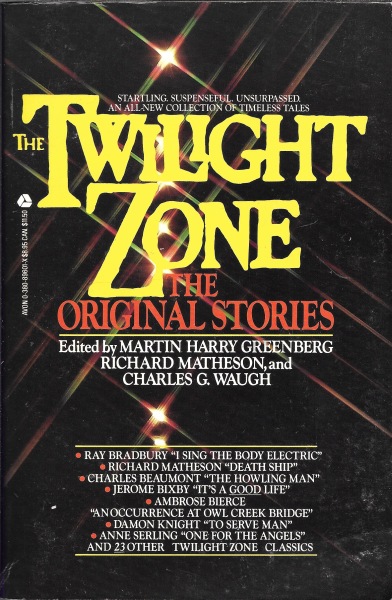
Matheson's excellent, ambiguous and suspense-filled short story is best known for its Twilight Zone adaptations. First in 1963, the year following the story's original publication. This episode is considered the strongest of a weak fifth season, as well as among the strongest of the entire series (the second of two TZ episodes to feature future Captain Kirk, William Shatner). The second adaptation was the high-point of the 1983 Twilight Zone: The Movie, a segment directed by George Miller and with a brilliant performance by John Lithgow. Both screenplays were written by Matheson, but the one for the movie retains the ambiguity, whereas the TV episode gives us external evidence that the creature did exist. I'm pretty sure I first read the short story in the 1985 anthology The Twilight Zone: The Original Stories (Martin Harry Greenberg, Richard Matheson & Charles G. Waugh, eds., Avon Books, July 1985), which I purchased in 1986. The story is not among his most anthologized, oddly less so than many a weaker piece, but remains in my opinion among his strongest.


For a concise bibliography, please visit the story's ISFdb page.

Friday, November 4, 2022

Casual Shorts & the ISFdb Top Short Fiction #1: Flowers for Algernon by Daniel Keyes

Keyes, Daniel. "Flowers for Algernon." The Magazine of Fantasy and Science Fiction, April 1959.


This article is part of my attempt to read the 155 stories currently (as of 1 November 2022) on the ISFdb's Top Short Fiction list. Please see the introduction and list of stories here. I am encouraging readers to rate the stories and books they have read on the ISFdb.


ISFdb Rating: 9.78/10
My Rating:     10/10


"Mr. Strauss says I shud rite down what I think and evrey thing that happins to me from now on."


Charlie Gordon is a mentally disabled thirty-six year-old man who is given the opportunity to participate in an experimental medical treatment that promises to make him intelligent. The treatment was recently tested on a little white mouse named Algernon, whose intelligence has since greatly increased, as per some basic cognitive tests. In order to monitor his progress, Charlie has been asked to keep a kind of diary, a series of "Progress Reports." These progress reports make up the novelette that is "Flowers for Algernon," and it is through his writing, and his constant evolving self, that we discover his character and those who populate the world around him. Among the many strengths of the story is not Charlie's evolution itself, and eventual devolution, but the criticism of society in the treatment of people who are different from the norm. Charlie's emotions are very real, as are the emotions experienced in reading this story.

A genuinely touching story of a man's desire to improve himself, and the transformation of his personality as he becomes "improved." Written with great sensitivity, humour and pathos, the story becomes tragic as we care for the characters who find themselves in such an unusual situation. Including that mouse. The sensitivity comes directly from the author, as Keyes developed the story over many years, basing its main points on experiences he gained while teaching special needs children. The story transcends its genre, since the only speculative element is the operation, which is primarily a device to allow its protagonist to see the world around him from two distinctly different points of view. Stripped of this element, we are left with character, which is truly the driving force behind the story, and their experiences are what makes the story so powerful. Remove character and we have a generic plot device. The only other portion of the story that focuses on the operation is a brief moment when a former colleague of Charlie's comments that the change in him is "not right," though these views may have been expanded in Keyes's novel version. (I read the novel too long ago to recollect its details; when I find the time to re-read I will update this last sentence.) As for the scientific method, a good deal here is outdated, as intelligence is defined by one's IQ and success is some specific tests (primarily mazes and the Rorschach test), though the increase in intelligence, as we better understand its meaning, is evidenced in Charlie's evolution.

I read the story this time from an e-copy of the original Magazine of Fantasy and Science Fiction issue in which it first appeared (April 1959, with cover art for the story by Ed Emshwiller). I read it a few months ago in the anthology Suspense Stories (Mary E. McEwan, ed. Scholastic, 1963), and noticed that some of the spelling errors differed between the two versions of the text. Likely Keyes made revisions throughout the years, particularly as the story took on different forms as a novelette (1959) and novel (1966), with several reprints in between. I first read the story in high school from the anthology Ten Top Stories (David A. Sohn, ed., Bantam, 1964).

"Flowers for Algernon" has been read by many, as it is a staple of speculative fiction, and has for many years been required reading in North American high schools, including my own. Apparently banned from time to time, it has persevered, being made the subject of various adaptations, including an Academy Award-winning film, Charly (1968; which I have not yet seen). It is among the few short stories that has such cultural significance that it can be mentioned/alluded to, and most people would have at least an inkling of an idea of what is being referenced.


You can visit this ISFdb page to view its incredibly broad publication history.


free counters

As of 24 December 2015