Showing posts sorted by relevance for query john keefauver. Sort by date Show all posts

Tuesday, June 24, 2025

John Keefauver, Research into Marginal Living


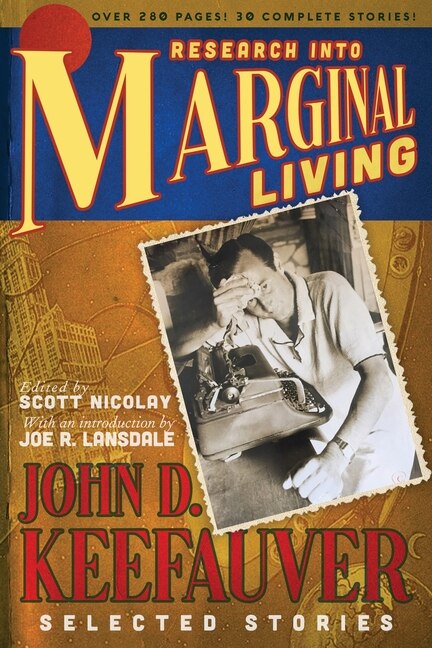
Keefauver, John D. Research into Marginal Living: The Selected Stories of John D. Keefauver. Edited by Scott Nicolay. Lethe Press, 2021.


Research into Marginal Living at the ISFdb
Research into Marginal Living at Goodreads

Overall Rating:     TBD/10


A dozen years ago (in 2013), I pleaded for the publication of a collection of stories by John Keefauver. Like many, I'd read a handful of his stories in various anthologies, and quickly realized that there are enough gems in the writer's oeuvre to produce even a slim collection. In August 2017, I received an email from author/editor Scott Nicolay, informing me that he was working with Mr. Keefauver's estate to bring his novel Tormented Virgin back in print the following year, along with a collection of his stories. Exciting news, but I did not receive a follow-up, and as I was busy with a one year-old daughter, I pretty much forgot about it.

Then in October 2021, someone posted on my review of Keefauver's "The Tree" that Nicolay was preparing a collection that should be out in early 2022. A quick search indicated that the book had been released the previous month.

In September 2021, Lethe Press released the first, long overdue, collection of stories by John Keefauver, titled Research into Marginal Living: The Selected Stories of John D. Keefauver. Few books have gotten me this excited, and of course I (eventually) ordered a copy.

I am only partway through, but decided to begin posting reviews of the stories as I read. So far the collection is excellent. Not only does it contain thirty short stories (selected from the allegedly 796 that he published during his lifetime), it has two very good introductions (one by Nicolay and another Joe Lansdale, who had included a couple of Keefauver's stories in his anthologies). In addition, Nicolay provides notes following each story that includes fascinating details about the stories and about Keefauver, hinting at the story-selling process over a handful of decades.

This collection is highly recommended, and you can purchase a copy at the Lethe Press website, where it is currently on sale for a mere $15! Please go support the project.


Oh Well What the Hell     7/10
Playboy, November 1958

A surprisingly enjoyable poem based on Lawrence Ferlinghetti's "A Coney Island of the Mind." Keefauver penned this homage months (or weeks) after the publication of Ferlinghetti's book. Throughout his career Keefauver would write other homages and parodies, showing a penchant for literary mimicry. We will see other kinds of mimicry in the collection, with stories produced for the Pan Horror Stories series, and with stories touching on a vast variety of styles. The best stories, though, are the ones he developed himself, lending his own Keefauverian touch.


The Daring Old Maid on the Flying Trapeze     7/10
Big Table #2, Summer 1959

This story emulates the work of the popular Beat writers of the time. The story follows the final hours of a former trapeze artist as she struggles down on her luck. While I am not an admirer of the Beat style, this story snuck up on me and surprised me with its bittersweet narrative. The title reflects the William Saroyan 1934 short story, "The Daring Young Man on the Flying Trapeze."


Kali     7/10
The Fifth Pan Book of Horror Stories, Herbert van Thal, ed., London: Pan, 1964

An American high school teacher visiting Calcutta becomes obsessed with a beautiful local guide. The woman, clearly not an official city guide, calls herself Kali, after the goddess with whom she is obsessed. She promises to take the gullible American to witness the sacrificing of a goat. My full review can be found here.


Give Me Your Cold Hand     7/10
The Sixth Pan Book of Horror Stories, Herbert van Thal, ed., London: Pan, 1965

While frantically helping to dig a man out from a collapsed tunnel on Carmel Beach, south of San Francisco, Tony notices a female bystander intently watching the scene. The woman has a noticeable presence: she is tall and powerful--sexually powerful--and Tony quickly falls for her. In turn, Anita is drawn to Tony, admiring his large, strong hands. She is drawn to men with large hands, but as her husband hit her with his before abandoning her altogether, to protect herself she carries a sharp darning needle in her clothing.

My favourite Keefauver story to appear in the Pan Books of Horror series.


The Last Experiment     7/10
Climax: Exciting Stories for Men, November 1960, Vol. 7, No. 2 (pp. 20-23)
The Seventh Pan Book of Horror Stories, Herbert van Thal, ed., London: Pan, 1966

A young US army private agrees to participate in a military sensory experiment.

... coming soon ...


Tuesday, July 1, 2025

Casual Shorts: John Keefauver, Kali


Keefauver, John. "Kali." The Fifth Pan Book of Horror Stories, edited by Herbert van Thal. London: Pan Books, 1964.
______. Oriental Tales of Terror, edited by J. J. Strating. London: Fontana, 1971.
______. Research Into Marginal Living: The Selected Stories of John D. Keefauver, edited by Scott Nicolay. Lethe Press, 2021.


Rating:     7/10


This review of "Kali" appears as part of my serial review of John Keefauver's first collection, Research Into Marginal Living.


An American high school teacher visiting Calcutta (now Kolkata), is sidetracked in front of the tourist office by a beautiful local woman. Our narrator is aware that this beautiful Indian woman is obviously not an official tour guide, but quickly he falls for her and allows her to lead him like sheep to see the sites of the city. The woman in turn is obsessed with the goddess Kali, and has taken on the goddess's name. Her personalized tour leads our narrator to a statue of the many-armed Kali, and, as promised, to witness the sacrificing of a lamb. This last experience traumatizes the American, and he returns home quite disturbed.

On the surface, "Kali" is a fairly standard story, one that was likely aimed directly at the Pan Book of Horror Stories series, as it features so many of the series elements. As he did with his homages "The Daring Old Maid on the Flying Trapeze" and "Oh Well What the Hell," Keefauver proves himself to be a master emulator, delivering a story perfectly geared for its intended target. The story contains several standard tropes, and it is evident Keefauver is aware of these tropes as he toys with them. There is a beautiful, foreign woman who everyone appears to fear but with whom the protagonist becomes obsessed. We are to expect that this woman is involved in black magic, or some form of mystical art, but it turns out she is simply mad, leading her to seduce gullible American tourists to feed her fantasy of being Kali.

Below the surface, however, there is an intriguing study of the dark obsessiveness of the narrator, rather than the straightforward, campy obsessiveness of the exotic woman. Early in the narrative, the teacher mentions he is curious about goat sacrifices, and while in Calcutta hopes to see one. Meeting the unregistered tour guide only serves to elevate this desire that he has long been harbouring. We can speculate that it is not the woman to whom he feels drawn, but rather toward the hopes of witnessing the sacrifice. And as expected in such a story, the protagonist gets more than what he hoped. But what is different here is that the narrator is not a victim and the woman not an actual witchy predator, as these women at the time were often presented. The woman is not at fault in driving him to his bloody, obsessive behaviour once he is again on American soil. The seed was already in him, as made clear in the beginning, and the woman is merely a trigger. Had it not been she, he would have been led by someone else to a sacrifice that would in turn have led him to committing his bloody acts. The woman certainly noticed the depraved desire in this man, and latched onto it, but not in the hopes of corrupting him, but simply in order to share her own depraved desires with an equal. Sure she drugs him, but he is an east target, allowing himself to be drugged, and once the deed is done, she simply allows him to leave, meaning no harm. It can also be argued that some other life event could have woken his killing nature, and he was actively in search to allow the nature to be released. Hence a vacation by himself in Calcutta, not the safest of cities for an outsider.

In brief, the woman is not the horrible seducer we expect in these tales, but the narrator is a man seeking to release his dark self. Likening him to the goat, as he is easily led by others, his unrelenting desire to sacrifice goats at the end of this experience can be likened to a sacrificing of his self, an act of self-hatred and not merely a bloodlust.

While "Kali" has some interesting points, and clearly offers food for thought, it is not among Keefauver's strongest stories. It is, however, well written, as his descriptions of the guide, the delivery of the narrator's voice, and the overall pacing of the story, are all quite strong. His stories aimed at the Pan series, emulating the Pan style, show his strengths at adhering to convention, and also at generating suspense and guiding his readers as well as Kali guides her tourists. They do not compare to the stories that would later become his own unique staple, but for what are, these stories are elevated by Keefauver's skill.

Tuesday, September 28, 2010

Casual Shorts 4: John Keefauver, "The Tree" (1997)

Keefauver, John. "The Tree." Manoa, Century of Dreams: New Writings from the Philippines. Honolulu: University of Hawaii Press. Vol. 9, No 2. Winter 1997. 86-90


The story is available online at JSTOR, for those with access.

Little-known writer John Keefauver has written some truly unique stories, among them "The Pile of Sand" (1971), "The Great Moveway Jam" (1979) and "The Tree" (1997). These stories are not about single individuals in crisis, but about communities faced with some unusual, even fantastical  situation, and it tells of how each community, in all its different facets, deals with their unlikely circumstance. In "The Pile of Sand," a large sand mountain appears one morning on a beach, and despite the incessant tides it refuses to get washed away. In "The Great Moveway Jam," near-future commuters (of 1999) are trapped in a three-month long traffic jam. These stories contain elements of magic realism, are written in a simple, distant and objective tone, and are more like Kafkaesque moral allegories than run-of-the-mill suspense or fantasy stories.

In "The Tree," an old and isolated community is forced to decide the fate of its most personal emblem: the elm tree that for generations has been used to nail death notices onto. The tree is dying, and after much debate, agricultural experts brought in from the outside insist that the tree is dying as a result not of natural disease, but of all the nails lodged into it. The town is therefore faced with a difficult choice: to remove the death notices and try to save the tree, or to continue nailing the notices until the tree finally dies. The townsfolk are split on this: the elders wish to keep the tree as it is, since they have waited all their lives for their names to be nailed onto it, and the notion of outliving the tree is looked upon as tragic. The younger generation is leaning toward removing the nails and the notices, to perhaps try another method of recording deaths, or of abandoning the practice altogether; some extremists believe the tree should simply be put out of its misery. Heated debate resolves nothing, and filled with anxiety the elders begin to die off at an incredible rate in order that their names be nailed to the tree while the issue remains unresolved and the tree is still alive.

I will not give anything more away as far as plot is concerned, but will discuss some thematic considerations, and herein some inadvertent spoilers might rest. What is most interesting is that the basis of the tradition has changed over time, and that the townsfolk appear to be clinging onto something that exists in a form different than that which their ancestors had intended. The tree was originally used for general notices, but later was taken up with solely death notices, names and dates of townsfolk etched onto "two-by-four-inch metal strips" and nailed to the elm. Moreover, many people expressed the uselessness of the tree, citing that in the town cemetery the names are all clear, whereas on the tree some notices are so weather-worn they are illegible, while others, with so little space remaining on the tree, were nailed near the top, invisible to those standing on the ground. Clinging onto this tradition clearly serves only a sentimental purpose, and somehow gives the town elders a kind of purpose in their meagre lives, as having their names on the tree is more important than making of their years something beneficial to others, to their town or even to themselves.

There is little left in this town for old and young. It has been dying for years, we are told; the once common construction has halted and most of the young have moved away, so that the town elders make up the majority of the population. Since the elders are the majority and since they are the ones clinging tightly to tradition, there is little sense that the town will survive this crisis and rebuild itself.

While the initial purpose of nailing notices onto the tree has been lost, elders now claim that the purpose of nailing death notices is for departed townsfolk to be united on something living. The tree is a perfect repository as it grows in the town's centre. Yet as the town dies so does the tree, and so do the notices, as the dates are rusting off the metal strips "the notices were dying too." (p. 87) In essence, it is the memory of this place that is dying. For years the townspeople have resented the encroachment of outsiders, did not approve of the young moving out, and have even talked of building a wall around the town to prevent outsiders coming in to look at their tree. While some were willing to prosper from their tradition, to invite the tourists and build a hotel and souvenir shop, the elders resented the encroachment and blocked the idea. Plans for change have long been suppressed.

In truth, though dying the village has long been dead. Its newspaper has long ago folded while "the twice-a-day train roared right through town, as if the place didn't even exist." (87) What has changed for the community is their awareness of the town's death and of their own inconsequential existence. The perverted notion of tradition that they are grappling with and the constant emphasis on death is only helping to kill the community, and it is only natural that the elm is dying since, as we are told, it was the symbol of the village's life.

Allegorically speaking the story has much in common with some of Kafka's shorter pieces, mostly in that the allegory can point to many different things. The town was overwhelmed with pride, its attitude toward the outside world and toward those wishing to leave forever prevented it from becoming a part of the world as a whole. The community was a victim of hubris. Yet not only pride, tradition can be linked to other abstract concepts, any form of ideology from religion to communism, taken to an extreme level that isolates itself from a world filled with different forms of ideology.

Whatever direction the allegory points it is clear that the story's protagonist, the tree, is a victim here. The village cannot be the victim since it is made up of its people, and the tree was usurped by the people into this perverted symbol for life that gave the townsfolk the tragic hope for an unattainable immortality. There was only so much that the tree could support, and after many generations it could do nothing but die.

The end of the story is obvious, indicating that man in his stubbornness, pride and lack of wisdom will not change, and that in order to preserve ourselves we continue to make victims of our environment. With "The Tree" Keefauver has given us an excellent short story, and it is truly unfortunate that the story, like his other stories, is not more widely read.


Thursday, July 18, 2013

Bibliography: John Keefauver

Unique and relatively unknown author John Keefauver deserves a greater audience. I have attempted to collect bibliographical data. For any additional publications or to correct any data, please comment or email at casual.debiris [at] gmail [dot] com.

A story was published in The Capilano Review, 1979.

In 1968, Keefauver won seventh place in the Writers' Digest Short-Short Story Contest, for stories on any topic up to 2,000 words, earning $100. This is according to the 15 August 1968 issue of the weekly The Carmel Pine Cone. It is not clear what the story was titled nor whether it was published anywhere.


Bibliography

  • "The Inside Out Black Whites and the Inside Out White Blacks," The National Review.
    • The Joys of National Review 1855-1980, Ed. Priscilla L. Buckley. National Review, 1994. (180-181)
  • "The Cat," The Old Line: Monthly Student Magazine of the University of Maryland, 16:2, 1949. (13-14)
  • "A Walk on the Stepped on Side with the Man with Golden Hair Growing Out of a Golden Toe," Carolina Quarterly, 11:1, Fall-Winter 1958. (46-57)
  • "Spring Revival," Caper, 6:1, January 1960. (41-42)
  • "Kali," The Fifth Pan Book of Horror Stories, Ed. Herbert van Thal. London: Pan, 1964. 189-200
  • "Give Me Your Cold Hand," The Sixth Pan Book of Horror Stories, Ed. Herbert van Thal. London: Pan, 1965. 93-109
  • "The Last Experiment," The Seventh Pan Book of Horror Stories, Ed. Herbert van Thal. London: Pan, 1966. 95-105
  • "Mareta," The Seventh Pan Book of Horror Stories, Ed. Herbert van Thal. London: Pan, 1966. 106-116
  • "The Most Precious," The Eighth Pan Book of Horror Stories, Ed. Herbert van Thal. London: Pan, 1967. 21-28
  • "The Diligent Barber," Daring, 8: 7, October 1969. 18-19
  • "Special Handling," Alfred Hitchcock Presents: A Month of Mystery. Ed. Alfred Hitchcock (Robert Arthur). New York: Random House, 1969. 283-287. Reprinted in A Month of Mystery: Book Two, Ed. Alfred Hitchcock (Robert Arthur), London: Pan Books. 103-107
  • "The Great Three-Month Super Supersonic Transport Stack-Up of 1999," Alfred Hitchcock Presents: Stories to Stay Awake By. Ed. Alfred Hitchcock. New York: Random House, 1971. Reprinted in Stories to Stay Awake By: Part I, Ed. Alfred Hitchcock. London: Pan Books, 1973. 219
  • "How Henry J. Littlefinger Licked the Hippies' Scheme to Take Over the Country by Tossing Pot in Postage Stamp Glue," National Review, 22 October 1971. Reprinted in Alfred Hitchcock Presents: Stories to Be Read with the Door Locked. Ed. Alfred Hitchcock. New York: Random House, 1975 (109-114); Stories to Be Read with the Door Locked. Ed. Alfred Hitchcock. New York: Random House, 1977
  • "The Pile of Sand," The Texas Quarterly, 14:3, Autumn 1971. Reprinted in Alfred Hitchcock Presents: Stories to Be Read with the Lights On. Ed. Alfred Hitchcock (Harold Q,. Masur). New York: Random House, 1973; The Carmel Pine Cone, 25 September 1975. 8-9
  • "Paste a Smile on a Wall," The Smith #15, 1974. (153-159) Reprinted in Alfred Hitchcock Presents: The Master's Choice. Ed. Alfred Hitchcock, New York: Random House, 1979. (183-188)
  • "Scream!" The 15th Pan Book of Horror Stories. Ed. Herbert van Thal. London: Pan, 1974. (107-112)
  • "The Chocolate Man," Eternity SF #4, February 1975. (29-34) Reprinted in Eternity Science Fiction #1, 1979. (52-57)
  • "The Great White Southern Sardine," The National Review, 6 August 1976. 843
  • "The Great Moveway Jam," Omni, 1:6, March 1979. (71-75)
  • "The Rocks That Moved," Omni, 1:10, July 1979. 103-134) Reprinted in The Best of Omni Science Fiction #3. Eds. Ben Bova and Don Myrus. Omni Publication, Inc., 1982. (74-77)
  • "The Jam," Sewanee Review, Vol. 88, No. 3, Summer 1980. 383-398
  • "Giant on the Beach," Omni, 2:7 April 1980. (49-52) Reprinted in The Best of Omni Science Fiction #4. Eds. Ben Bova and Don Myrus. Omni Publications Inc., 1982. (128-130)
  • "Snow, Cobwebs, and Dust," Shadows 4. Ed. Charles L. Grant. New York: Doubleday, 1981. (167-170)
  • "Body Ball," Omni, 3:4, January 1981. (72-77) Reprinted in The Best of Omni Science Fiction #5. Ed. Don Myrus. Omni Publications, Inc., 1983. (120-123)
  • "Escape," Rod Serling's The Twilight Zone Magazine, July 1981. (74-79)
  • "Neutron Warhead vs. Mustard Gas," Pulpsmith, 1981.
  • "Uncle Harry's Feet," Short Story International, 4:16, December 1984. (59-
  • "The Ventriloquist," Pulpsmith, 1985.
  • "Cutliffe Starkvogel and the Bears Who Liked TV," The Best of the West. Ed. Joe R. Landsdale. New York: Doubleday, December 1986. (52-58)
  • "Candy Skulls," Pulpsmith, 7:1 Spring 1987. (98-120)
  • "Kill for Me," Masques III. Ed. J.N. Williamson. New York: St. Martin's Press, 1989. (285-292) Reprinted in Fleshcreeper: Startling New Works of Horror and the Supernatural. Ed. J.N. Williamson. Robson Books, 1990; Darker Masques, Ed. J.N. Williamson. New York: Pinnacle Books, 2002. (272-278)
  • "Uncle Harry's Flying Saucer Swimming Pool," The New Frontier: The Best of Today's Western Fiction. Ed. Joe R. Lansdale. New York: Doubleday, 1989. (29-33)
  • "Dead Voices Live," Dark at Heart. Eds. Joe R. Lansdale and Karen Lansdale. Arlington Heights, IL: Dark Harvest, 1992. (241-252)
  • The Three-Day Traffic Jam. New York: Simon & Schuster Books for Young Adults, 1992.
  • "The Tree," Manoa, Vol. 9, No. 2, Century of Dreams: New Writing from the Philippines, Winter 1997. 86-90


Tuesday, September 23, 2025

Casual Shorts: Give Me Your Cold Hand by John Keefauver


Keefauver, John. "Give Me Your Cold Hand." The Sixth Pan Book of Horror Stories, edited by Herbert van Thal, London: Pan Books, 1965.

Rating:     7/10


While frantically helping to dig a man out from a collapsed tunnel on Carmel Beach, south of San Francisco, Tony notices a female bystander intently watching the scene. The woman has a noticeable presence: she is tall and powerful--sexually powerful--and Tony quickly falls for her. In turn, Anita is drawn to Tony, admiring his large, strong hands. She is drawn to men with large hands, but as her husband hit her with his before abandoning her altogether, to protect herself she carries a sharp darning needle in her clothing.

Tony and Anita's relationship progresses quickly, and he moves into her and her husband's million dollar home on Pebble Beach. Yet shortly after moving in, Tony becomes annoyed at her obsessive need to keep the needle on her person. In fact, he is creeped out by not only Anita, but by groundskeeper George, who believes Mr. Nelson, Anita's husband, communicates with him. Tony's aggression and Anita's passion clash, and their relationship quickly begins to sour.

This story is surprisingly suspenseful, and has a plot more layered than most of the standard stories that appear in the Pan Books of Horror Stories. Of his six stories to appear in the Pan anthologies (four originals, one reprint and one re-write), this one is my favourite.

The structure here is a little different as well. A good opening scene takes place following the events of the story, describing a group of cops digging in the rain, and beside the hole is a covered corpse. Meanwhile narrator Tony and groundskeeper George sit and watch, handcuffed together. Some clues mixed in with some misdirection.

This story was (much) later re-written as "Dead Voices Live" for the 1992 Joe Landsdale-edited anthology Dark at Heart. It would be interesting to know what led to the decision to re-write an early story.

For more Wednesday Short Stories, please visit Patti Abbott's blog.


Friday, June 13, 2014

George C. Chesbro, "Strange Prey" (1970)

Chesbro, George C., "Strange Prey," Alfred Hitchcock's Mystery Magazine, August 1970
_____, Strange Prey and Other Tales of the Hunt, Apache Beach Publications, December 2004

_____, Shadow of a Broken Man, New York: Simon & Schuster, 1977


"Strange Prey" at ISFbd
"Strange Prey" at IBList

Rating: 7/10

For more Friday's Forgotten Books, please visit Evan Lewis's blog.

As a pre-teen in the late eighties I used to pick up back issues of different magazines in a neighbouring used bookshop for mere change. My favourite at the time was The Alfred Hitchcock Mystery Magazine, and I'd nab those ugly colourful browning issues from the 1960s and 1970s off the crowded shelves. The excitement whenever the little cluttered shop received another wave of those issues is fondly remembered. One reason I liked AHMM is that, other than the colourful interior artwork and the fact that I was, thanks to my mother's healthy influence, a huge fan of the director himself (who had nothing to do with the magazine outside of image and name and nepotism--his daughter Pat was involved), there was a wide range of stories collected. The magazine did not shy from stories that fused mystery with science fiction or fantasy, a feature which at that impressionable age was a welcome novelty, and I looked forward to stories from the likes of John Keefauver and Theodore Sturgeon in the AHP anthologies, and Robert Twohy and George C. Chesbro in AHMM. With Chesbro there were two stories that particularly gripped me: "Short Circuit" (AHMM, October 1971) and the novella "Strange Prey" (AHMM, August 1970).

"Strange Prey" features renowned architect Victor Rafferty, recent survivor of a terrible car accident and miraculous life-saving operation, who learns that he has the ability to read minds, and albeit with some painful difficulty, telekinetic talents. Rafferty is pursued by the government that wishes to use him as a super spy, a potential weapon against, among others, the Soviets. Rafferty, however, wants only to be left alone and to live happily with his wife Pat. At the time the story was no doubt original, whereas now it reads like a plot-line from the X-Files.

At that time this was among my favourite AHMM stories, as it featured elements of science-fiction along with suspense, a fast-paced plot, government corruption and a non-conclusive ending. Though the story holds up well enough, I wouldn't rank it today as among my favourites. Then again, my jaded adult self probably wouldn't rank most of these stories as highly as I did back in that era of innocence. I recently discovered that the story was the basis for the first of the "Mongo" books, Shadow of a Broken Man, and having read it before my "Strange Prey" re-read, am surprised to find that pretty much the entire novelette is adhered to by the novel, as detective Mongo tries to discover the mystery behind the architect's death and possible resurfacing. (I will post my review for the novel soon enough.)


Saturday, June 18, 2011

Various Authors: Stories from The Fiction Desk 1 (2011)

Various Authors: Stories from The Fiction Desk 1, edited by Rob Redman, The Fiction Desk, 2011. 188 pp

There seems to have been a number of new journals appearing over the last little while, literary to genre, Prole to Dark Moon Digest, and many others promising to appear soon. The quality of these journals tend to be a little all over the place, especially when first starting out, attempting to recruit talented writers, uncover good slush, and hopefully pick up a few readers along the way. I like to support new publications and urge the reading and (especially) writing public to do so as well, since a healthy subscription allows for better long-term quality, and, if nothing else, at least survival.

And if it weren't for these new journals, we wouldn't have such excellent books as Various Authors. I have read a number of new and established fiction journals over the past two years, and Various Authors is without hesitation the strongest, most compelling of the group.

Various Authors is the first anthology published by the fine blog The Fiction Desk, by Rob Redman. The book is attractive, more book-like than journal-like, with a nice cover and great, easy-to-read layout. The quarterly's great looks are surpassed by its consistently readable contents. There is not one bad story among the dozen collected here, and at least half are above the average. Of course this can range from one person's taste to another person's, but the variety here is immediately noticeable, and I am pleased that the journal is unafraid to print serious fiction, from short stories to sketches, serious and comedic, along with fantasy and the absurd. It is this variety that is missing in many contemporary journals, especially the most established ones. Journals with broader readership might feel that, since they have wide and loyal readers, they need to cater to the tastes of their perennial subscribers. If the people at The Fiction Desk maintain this level of consistency, I will be a perennial subscriber. Indeed, I am already itching to see issue number two.

As for which is the strongest story of the group, The Fiction Desk offered a generous prize for the best story, as voted by its authors. There was a three-way tie, so book blogger John Self (The Aylum) was brought in to select one of the three, and the prize went to the excellent "Crannock House," by Ben Lyle, which would probably have been my personal second choice.


"Two Buses Away" by May Lynsey. 6/10
This is a character sketch of a young, lethargic man that plays itself out in a triptych of scenes: Gerry on the bus on his way to visit his parents; Gerry at his parents'; Gerry waiting for the bus after having visited his parents. It's a simple and generally underwhelming series of events, but a subtle yet powerful change occurs in its course. While at his parents', Gerry learns that things between his folks are not too healthy and that his mother has moved out, possibly permanently, yet nothing concrete is offered. Permanent or not, this little chip in Gerry's universe alters his attitude and world-view; the world is not as stable and predictable as it may have been for a child. The adult world is unreliable, and Gerry's self-contained bubble has burst. While the most interesting portion of the story is its middle, a very well written scene between son and father, with tight dialogue and an immeasurable weight of tension, the two bookend moments are the ones that illustrate the change in Gerry. It is through his interaction with strangers, commuters specifically, that we note the transformation, for the once seemingly harmless figure in the world have now become potentially deadly.

Though a great little sketch and well written, I would not have chosen it to open the volume, but would have the subtlety nestled between two more "active" stories.


"How to Fall in Love With an Air Hostess" by Harvey Marcus. 5/10
In this humourist piece of self-referential fiction, the author/narrator/protagonist places himself on a train seated not too far from an attractive stewardess (air hostess, if you want to be politically up-to-date), and considers how he should approach her. The goal is, of course, not so simple as love, but a consideration of eternal happiness amid the wasted past, a past enveloped with youthful apathy. The piece is inconsistently funny though the humour is there, and though it evokes some interesting ideas, it only touches upon them, so that thematically it becomes as light and evasive as our protagonist's world-view. While it lacks both the subtlety and depth of the first story, it is nonetheless enjoyable, and a good contrast to the darkly serious opener. Somewhat reminiscent of Lorrie Moore's "How to Become a Writer," though not as funny, nor as subtle or memorable.


"Crannock House" by Ben Lyle. 7/10
At Crannock House boarding school, an alternative education school in rural Scotland, a young teen befriends Mervyn, the new, eccentric Mathematics teacher. More accurately, the teen narrator forces friendship onto the other, a quiet recluse seemingly content with his home-brew cider, crossword puzzles and made-up games.

The story title is misleading: it's not about the school itself, though it at first appears to be, but about the two men, their friendship, and about the notion of friendship itself. It's not a fuzzy friendship story, but rather shows the darker implications and the inherent responsibilities of friendship. Ben Lyle has put together a multi-dimensional story, at times comic, always vivid, and finally powerfully tragic. Amid these vast dimensions are smaller, creative details, such as the word games and how "nutant" and "beriberi" get incorporated incorporated into the text. An excellent work, and deserving of the prize for Various Authors's best story.


"Rex" by John Wallace. 7/10
Rex's wife has been grieving now for some time since the loss of her beloved dog, so Rex is surprised when he hears playful voices and laughter coming from the bedroom. He enters the room to see her with a dog, as we expect, but surprisingly (and a great surprise it is) it's not a dog so much as some guy in a dog suit. Rex soon learns the dog, William, is an actor (a method actor, I suppose) who takes his role as beloved household pet very seriously, so seriously he is even willing to eat dog food. Well, feeling that it would be best not to disappoint his wife, Rex decides to play along along her wounds begin to heal.

"Rex" is a truly enjoyable story, not just for its quirky fun and originality, but the idea of how far one must go to keep up appearances becomes pleasantly crazed. The little complication that Rex never cared for dogs is a nice touch, and the story is not so much about Sylvia's coming to terms with losing her companion, but about Rex having to face and deal with glitches in their relationship. While he appears to want what is best for his wife, Rex is actually thinking only of himself. Fairly passive and non-confrontational, Rex takes advantage of the advantages of the situation, learning from William his wife's secrets (since people talk to their dogs more openly than to their spouses) rather than learning to listen and understand his partner's needs. He is disinterested in her interest in dogs, and it's likely she wants a companion because Rex himself is so withdrawn. Indeed, he is happy whenever William informs him that she wants to be alone, taking advantage by having drinks with the guys or simply walking by himself in the park (perhaps the same park where Sylvia takes William to share her secrets with). Of course this is all speculation since little detail is even offered about their past and the evolution of their relationship, but there is a reason why the story is titled "Rex" instead of "William," "Sylvia" or something silly like "Dog Day Afternoon"; the story is about the guy and not the grieving process, and the guy's name, Rex, is a name common to dogs, while as the dog's name, "William," is not only common to human males, but generally evokes the image of a decent man (as opposed to something like, say, "Butch").


"The Puzzle" by Alex Cameron. 5/10
An elderly stroke victim bound to a wheelchair in a retirement home is surprised when a stranger leaves him a small package. His attending nurse, Bertha, opens the package to reveal a jigsaw puzzle, and helps him to assemble it. Once involved in the art world through shady means, secrets from the man's past come back to challenge him.

A quiet narrative, and though well written I did not find it as engaging as the other stories. Much of the back-story is told through exposition, and the ending is just too dramatic and overdone for something so quiet, especially that final paragraph. Yet the prose is good, visually precise and, ending aside, smooth and consistent.


"Dave Tough's Luck" by Matthew Licht. 6/10
A former drummer turned drumming teacher takes on a new student, Andy Shrover. Andy is the member of a large, musically talented family, yet through a birthing accident was left brain damaged. Drumming instructor soon discovers, however, that little Andy has talents of his own, and does not merely ape what he hears. Through his idol, the great Dave Tough, our narrator tells of his attempts to bring Andy's talents to light, but the parents won't listen, especially since we're talking noisy drums rather than classy violins. Andy, like the drum, is society's perceived "retard."

I liked the story well enough, with its interesting ideas and energetic writing, the fragmented sentences that often sound like percussions themselves. The structure, however, could have used some tuning. For such a short story the preamble is too long and I was waiting and waiting for the story to start. To me it started at the line, "The first time I saw Andy, he had a kooky smile stretched over his entire face," and I wondered why the author didn't start it here, fitting in the necessary preamble info later and doing away with padding. The title, however, is quite neat, evoking the expression "Tough luck!"


"Assassination Scene" by Jason Atkinson. 7/10
"A government job means that you are set for life... if you suddenly fade out... They'll find a little corner for you in the complex mechanism and there you will sit until retirement."

Middle-aged Washington DC government employee Daniel is about to encounter change. In fact, he will soon be assassinated. When he calls young rookie employee Sadie to his office to warn her that it has become apparent that she is the first to leave for the day, he learns that she has been busy directing a play: William Shakespeare's Julius Caesar. Well, it turns out they need some smaller roles filled, and Daniel might do. In fact, when he proves to be a good reader, Sadie asks him to try out for the part of main man Caesar himself (though of course we all know that Caesar is not the star of Shakespeare's play, but a middling character, along the lines of the ghost of King Hamlet). This is a simple story with a simple lesson, yet well written with a great last line. The tone and language is distant, very formal, like Daniel himself, and like Daniel it wants to be more. The interview with Sadie is well constructed, with Daniel fighting between wanting to be a part of her project, and his official government side creeping in to warn him it is not a good idea. The assassination is, of course, a metaphor, a symbolic death, a removal from the corner Daniel has been shuffled into.


"Celia and Harold" by Patrick Whittaker. 8/10
As a result of re-routing of train lines, a man finds himself waiting for a transfer in the village of Midwick. While biding his time at the local pub, a resident barfly warns him to leave for his own good. What seems like an ordinary story premise soon becomes quite original, so original and engaging that I don't wish to discuss it anymore for fear of removing any of its inherent suspense for other readers. Hopefully this story will re-surface in another anthology over the next couple of years as it needs a wider audience. "Celia and Howard" is my vote for the best Various Authors story.

[Spoiler: Elements of fantasy and literature combine for a tight piece that can be read on many levels, from an unusual yet horrific form of apocalyptic plague, to a story about a man finding his place in the world. Our narrator is unnamed and, in many ways, unformed; he is a professional working in the city and living in its outskirts. A modern English everyman. What he finds in Midwick (perhaps named in homage to John Wyndham's Midwich) is the opportunity to begin anew, to leave his generic work and self behind, and head out, no longer alone, to redefine himself. The story's sense of the absurd is wonderfully rendered in a straightforward, realistic tone, that the fantastic is almost ordinary. Reminiscent of the stories of the neglected John Keefauver.]


"All I Want" by Charles Lambert. 7/10
While teaching English in beautiful Italy, a pair of roommates befriend a local couple, and spend a weekend at their house on Lake Garda. Teddy is interested in the woman, Anna, imagining a wealthy woman who could spoil any man with material wealth, while Simon the narrator is interested in Luigi, a somewhat dark, even mysterious traditional Italian man who carries a gun in his suitcase. Yet another well written story, with some great character portrayals, excellent dialogue, and a story filled with fine contrasts and disturbingly repressed emotions.


"A Covering of Leaves" by Danny Rhodes. 6/10
Train station employee Webster is at work following a tragic train wreck. He is watching the sparse crowds, the ample leaves that he is sweeping from the track points, the incessant rain, and the cars abandoned in the parking lot. These cars, he speculates, belong to victims of the wreck, and watches as one by one they are claimed, except for the little red Nissan parked at the far corner. A sad sight indeed, until one day the Nissan drives away... all by itself, and Webster quickly pursues. An eloquent fantasy dealing with grief and loss, loss of people as well as places. The loss of one's past is also affected, especially when attached to memories of those we have loved. A nice, quiet little story.


"Sometimes the Only Way Out Is in" by Ben Cheetham. 5/10
Ten year-old Finn runs away from from home as his mum lies in a drug-induced stupor and the social worker has come to (re)claim him. He decides to seek out his dad, and from a family trip a few years ago, he believes dad is living in Wales, so he heads off on foot. Meanwhile, Finn has a voice in his head named Zack who is more mature and rational than he, so I suppose they both head off. Frightening things happen in a the darker edge of town as some shady figures appear in Finn's path. This story, the longest in the collection, failed to grip me. I thought it well written and interesting enough, but I read it slowly, a couple of times checking to see how many pages were left, and all in all, it left me unsatisfied. The problem for me was that the story never seemed to have any concrete direction, that it just wandered aimlessly, and the fact that a ten year-old with a voice in his head had more purpose than his narrative is indicative of its weaker points. Why am I reading this? I wondered, and as soon as I was done I stopped wondering about the story altogether. Moreover, I did not care for the title.


"Nativity" by Adrian Stumpp. 6/10
Adrian Stumpp's "Nativity" begins as a kind of rant, the kind of rant on middle-class suburban life and the dark and looming reality of fatherhood a stand-up comic might deliver. Only, the story is not terribly funny, the writing stiff in that attempt to generate comedy through the serious learned language of an academic. Yet the narrator of this rant, thirty-five year-old Dr. Edward Devereaux, is an academic, and the more we learn about him, the more the ungrounded opening begins to make sense. The narrative swerves from ranting to a portrait of Devereaux's upbringing, so that we can understand where his anxieties come from. Despite the almost irritating beginning, stemmed from the fact that the narrator came across as whiny and selfish, "Nativity" is a powerful story about inherent family ties, responsibility, faith in one's self, and so many other little interwoven things that culminate quite nicely.
Monday, November 22, 2010

Casual Debris Presents: An Introduction to the Alfred Hitchcock Anthologies

As a companion to this essay, I am attempting a bibliography of the Alfred Hitchcock anthologies, a work in progress which can be accessed at Casual Debris Presents: the Alfred Hitchcock Anthology Bibliography.

Here is a preliminary overview of the anthologies.


In 1945 Alfred Hitchcock was approached by Dell to put together and introduce an anthology of suspense stories which was published as Suspense Stories Collected by Alfred Hitchcock, and reprinted several times with different titles over the next few years. It was an odd mishmash of stories, but despite being a little all over the place it proved successful, and in about a decade Hitchcock would find himself marketed to the extreme. In 1946 Dell Books released the follow-up Alfred Hitchcock Presents: Bar the Doors, arguably the best of all the first series of anthologies borrowing his name. By the end of 1949 a total of six books were published, followed by a hiatus that lasted until 1957.

In 1955 CBS helped launch what was to become among the most successful and longest-running television anthology dramas, Alfred Hitchcock Presents. Hitchcock himself directed the first episode, "Revenge," and three more episodes for the opening season. December of 1956 saw the first issue of the still-running Alfred Hitchcock's Mystery Magazine, and soon the anthologies were revamped full force. In 1957 one of the more popular anthologies was published by Simon & Schuster: Alfred Hitchcock Presents: Stories They Wouldn't Let Me Do on TV, ghost edited by Robert Arthur. (It became so popular that not only was it extensively reprinted over the years, the network backed away and allowed him to "do" many of the included stories.) These three ventures became intertwined. The magazine published original suspense stories, the television show adapted many of them, and the anthologies eventually became reprint venues for the magazine stories.

Among the writers who benefited from this trio of projects was the prolific Robert Bloch, whose short stories were frequently published in the magazine, and eventually adapted, many by his own hand, for the television show (a total of ten episodes for the original series and seven more for the extended Alfred Hitchcock Hour). It was perhaps through this collaboration that Hitchcock later came across the 1959 novel Psycho, the rights of which he quickly purchased. (In fact he also went ahead and purchased as many copies of the book he could find just so that his potential audience would be less likely to know the ending to his film adaptation.)

Another writer to benefit was Henry Slesar, who wrote several teleplays for a variety of shows throughout the 1960s, including Batman and The Man from U.N.C.L.E. Slesar had a record thirty-six teleplays or adaptations for AHP, with ten more for AHH, as well as one for the 1985 AHP remake pilot and three for the actual show. His stories were so adaptable and many of them well adapted indeed, that two paperback collections of his adapted stories were published under Hitchcock's name: Alfred Hitchcock Handpicks and Introduces A Bouquet of Clean Crimes and Neat Murders (NY: Avon, 1960) and Alfred Hitchcock Introduces A Crime for Mothers and Others (NY: Avon, 1962).

The anthologies were published in the US and the UK, successful on both sides of the ocean, but the magazine fared well only in the US. The British version lasted eleven issues, from September 1957 to August 1958 (no issue appeared in July), and later for five issues between May and September 1967. The Australian version, titled Alfred Hitchcock's Suspense Magazine, was published in 1957 and 1958, though I haven't yet been able to figure how many issues were printed, since it appeared to have gone through a reincarnation or revamping of sorts after #11.

In the 1960s the Hitchcock anthologies broadened in scope, with Robert Arthur, creator and author of the first Alfred Hitchcock and the Three Investigators books, hired by Random House to ghost edit some truly fine alliterative young adult collections, from A Haunted Houseful and Sinister Spies, to Monster Museum and Daring Detectives; it was actually his Spellbinders in Suspense that helped transform me into an avid reader as a child. Arthur also ghost edited some adult books, including the popular Stories They Wouldn't Let Me Do on TV, Stories My Mother Never Told Me, Stories that Scared Even Me and Stories for Late at Night. He received a note in each of these ("The editor gratefully acknowledges the invaluable assistance of Robert Arthur in the preparation of this volume"), though it was many years after his death that the extent of his "assistance" (i.e. he did everything) was made public.

Another ghost editor in the mid-sixties was British anthologist Peter Haining, who ghosted a handful of collections for Pan Books in the UK. The only other person I am aware to have ghosted one of these anthologies is Harold Q. Masur, who put together the 1973 Stories to Be Read with the Lights On. This may have been a result of the unfortunate passing of Robert Arthur in 1969.

Throughout the 1960s and 1970s the adult anthologies were being published regularly, and each ran through various reprints. An annual hardcover anthology appeared and was reprinted as two separate paperbacks, first with the original titles or variations of, as well as completely different titles. (For instance, Stories for Late at Night was published as 12 Stories for..., More Stories for..., and later on simply as Skeleton Crew.) Other collections were retitled after minor changes were made, such as Suspense Stories which, with the addition of another story, became 14 Suspense Stories to Play Russian Roulette By, and later 14 of My Favorites in Suspense; these are all the same book.

The early anthologies were excellent works, especially those ghosted by Robert Artur, who selected a truly wide array of short stories, novelettes and even novels of a variety of genres and styles. By the 1957 revamping of these books, Hitchcock himself had little to do with the publications (by little I mean nothing, as I suspect that even the brief introductions were ghost written; there is a distinct difference in approach and tone with those published in the 1940s, and let's remember, Arthur himself was well practiced in putting words in Hitchcock's mouth, since he made the director a character in his Three Investigators series). It is truly unfortunate that Arthur never gained the recognition as a first-rate editor, though I am certain he enjoyed his career, working not only on these books but on his own writing and on the scripts for the AHP television show.

By the 1970s the annual hardcover publications became reprints of more recent work, primarily from the most widely read mystery magazines of the time: Alfred Hitchcock's Mystery Magazine, Ellery Queen's Mystery Magazine, The Mike Shayne Mystery Magazine. Soon the anthologies would become straightforward reprint venues for the magazine. Davis Publications, through their Dial Press imprint, published annual and sometimes bi-annual (it peaked as a quarterly in 1983) numbered anthologies which were essentially "best of" the magazine selections from the previous year. These were initially edited by then magazine editor Eleanor Sullivan (claimant of the first non-ghosted Hitchcock anthology) and later Cathleen Jordan; the first was published in 1976. By then the magazine had been publishing monthly for twenty years and had accumulated enough material to print any number of anthologies reserved for only AHMM stories; some stories even re-appeared in many of these collections so that the books were truly less than unique.

The late 1970s brought about a new era in presenting these works, with the hardcover editions employing titles along the lines of Tales to Take Your Breath Away, Tales to Keep You Spellbound, Tales to Scare You Stiff and so on, while their softcover counterparts were simply numbered, beginning with Alfred Hitchcock's Anthology #1, though later had their own, less clever, subtitles, along the lines of Death-Reach, Fear and Borrowers of the Night. I'm not yet sure when the hardcover editions stopped printing, but the numbered anthology publications ceased in 1989 with Anthology #27: Murder & Other Mishaps. Furthermore, these works were no longer ghost edited though still introduced by "Alfred Hitchcock" (sometimes bearing his signature in print).

It is really the covers and the titles and the publishing phenomenon that make these books nice collectibles. While the hardcovers are not terribly interesting the look at, the paperback incarnations are fantastic, especially those published by Dell. Many are fairly easy to find since they've been printed and re-printed over the years, and some have several editions with their own unique covers that, sad as it might appear to some, I own different editions of the same books. Overall the contents vary from good classic and modern reprints to the generic magazine entries, and some of these tend to be tiresome. However, it is a great consequence that some fine, forgotten and never really known authors were included in these books, including McKnight Malmar and John Keefauver, whose original and excellent short stories, such as "The Storm" and "A Pile of Sand," can be (re)discovered. Finally, Robert Arthur provided us with one of the best suspense anthologies ever compiled, with Stories for Late at Night.


[Note: It is frustratingly difficult to find accurate information on these publications, so much of what I have put together here is educated speculation, which means it sounds valid but could be utterly incorrect. Anyone with information to share, please do so; comment or for anonymity email me at casual.debris@gmail.com.]
free counters

As of 24 December 2015