Friday, December 18, 2015

Ed McBain, The Empty Hours (1960)

McBain, Ed, "The Empty Hours," Ed McBain's Mystery Book #1, 1960
______, "The Empty Hours," The Empty Hours, 1962
______, "The Empty Hours," Academy Mystery Novellas 2: Police Procedural, ed. Martin H. Greeburg and Bill Pronzini, 1985
______, "The Empty Hours," Sleuths of the Century, ed. Ed Gorman and Jon L. Breen, NY: Carroll & Graf, 2000

Rating: 7/10

The Empty Hours at Goodreads
The Empty Hours at IBList

For this week's Friday's Forgotten Books, please visit Patti Abbott's blog.


This lesser known novella of Ed McBain's 87th Precinct series is a quick, well written procedural, and though the overall idea has been seen in different forms, McBain (Evan Hunter) combines the grittiness of New York's darkest moments with a bittersweet tale of two bound women.

The novella follows the investigation of a young woman found murdered in her shabby apartment. Yet despite her meager dwelling, her drawers are filled with new clothing, wears expensive underwear, stores large amounts of cash in a safety deposit box, and has a second bank account comfortably weighted with $60,000. McBain intersperses the investigative scenes with descriptions of the city, some characters, and some bits about life and writing. My favourite aside is the opening to Chapter eight, which works as a great passage on writing and the reality of investigative police work, which both sheds light on and contradicts the writing itself.

"There are no mysteries in police work," McBain write. "Nothing fits into a carefully preconceived scheme... There is no climactic progression; suspense is for the movies." It's true that fiction is a stylized form of reality, where a certain level of order exists and in many cases is required in order to maintain its own sense of reality, to generate its inner reality that most readers require. Of course McBain's stories contain their own structure and order, and "The Empty Hours," like any other successful work, is approached with its plot and certainly has a climactic progression. Admittedly, though, McBain's story gives the allusion of plotlessness, as though the events are unfolding of their own accord. As though his plot is being churned out by the events themselves. It is a statement of his skill that the story unfolds with the straightforward, gritty nature of an actual investigation.

Moreover, the scenario of the two closely linked women and the unfortunate tragedies they encounter is tinted with genuine sadness, and the pathos is heightened by the straightforward telling of their circumstances; had we encountered an emotional write-up it likely would not be as affecting.

A story worth hunting down.


Thursday, December 10, 2015

Steve Hamilton, A Cold Day in Paradise (1998)

Hamilton, Steve, A Cold Day in Paradise, Minotaur, 1998
______, A Cold Day in Paradise, Minotaur, 2000 (pictured)

Rating: 7/10

A Cold Day in Paradise at Goodreads
A Cold Day in Paradise at IBList

For this week's list of FFBs, please see Patti Abbott's blog.


Steve Hamilton's first novel, also the first novel in the Alex McKnight series, is undeniably strong. I enjoyed it not primarily for its mystery and suspense, which does waver throughout, but for its presentation of its main character and his integration within the plot and locale.

In brief, Alex McKnight is a former Detroit cop now retired in the backwoods of northern Michigan. The early retirement was a result of having been shot three times while on duty in an incident that left his partner dead. An incident that also left McKnight heavily and understandably scarred. Fourteen years following the event, as McKnight is practicing to become a local private investigator while maintaining his late father's hunting shacks, Maximilian Rose, the madman who shot him, has re-surfaced in his community of Paradise (hence the novel's title).

The focus that Hamilton places on Alex McKnight's psyche over what happened so long ago, and how it drives him in the wake of seemingly impossible events, works particularly well. It is deeply entangled with the plot and mystery that it never appears heavy-handed, and our concern for the suffering McKnight is genuine. It helps that McKnight is a less than stellar model of the ethical individual, nor is he a fearless former cop who thrives in the wake of violence. McKnight is instead headstrong, often impatient and rude, qualities that might win him some minor battles as a P.I., but in the long run won't garner him any favours. More striking, however, than his reactionary attitude, is the crippling fear that has been plaguing him his entire life, heightened by the shooting in Detroit. This is McKnight's central flaw, one that prevented him from acting against Rose and played a role in his former partner's death, and one that promises to be a handicap for any potential career as P.I. Like Lawrence Block did with Matthew Scudder, Hamilton has set up a protagonist who was directly responsible for the death of an innocent, and gains our sympathy as we read of their struggles and changed moral outlook.

An interesting aspect of the novel is the contrast between McKnight's overcoming his fear yet establishing a deep form of isolation within his community. Though some relationships with minor characters do not change, every positive relationship he has or has had with any important character devolves to the point that, aside from his pub buddies, he is left completely alone. The only exception is, arguably, Leon Prudell, who despite not being a friend establishes the possibility of becoming a future ally.

I mentioned early that the plot wavers, though it is not a drastic wavering and it never gets close to being derailed (no real spoiler here as I only hint at the issue). Half-way through the novel a man is taken down whose involvement in the mystery is obviously a plant. From this event we are led off the so far well maintained plot path, yet the confusion it seems to want to generate only led me to reasoning out the main elements of what was actually transpiring. The problem is that it is so obvious a plant that rather than becoming scattered, my (usually scattered) mind became instead focused, and the spell of suspense was cracked. Regardless, the denouement is satisfying and the character climax, more important in several respects, works nicely.

The novel was generally well received, and also garnered a number of award nominations and awards, including the St. Martin's Press/Private Eye Writers of America Best First P.I. Novel by an unpublished writer. Following publication the book received Best First Novel awards from both the MWA (Edgar Allan Poe Best First Novel) and the PWA (Shamus Best First Novel), and was a finalist for the Anthony and Barry First Novel awards.

Thursday, November 12, 2015

Alvin Schwartz, Scary Stories to Tell in the Dark (1981)

Schwartz, Alvin, Scary Stories to Tell in the Dark, illustrated by Stephen Gammell, J.B. Lippincott, 1981
______, Scary Stories to Tell in the Dark, illustrated by Stephen Gammell, HarperTrophy, 1986 (my copy)

Rating: 7/10

Scary Stories to Tell in the Dark at Goodreads
Scary Stories to Tell in the Dark at ISFdb
     (view a list of editions, printings, covers, etc.)


For more Friday's Forgotten Books, please visit Patti Abbott's blog.


Given its oral tradition and its transcendence of culture which contribute to its widespread popularity, the folk tale often lacks its intended wallop of surprise. Unless, of course you, are a youngster first encountering these tales. In my youth I was introduced to many such tales through reading young adult fiction (or as we called it back in the 80s, kids' books), including re-tellings of classic tales; one particular volume I recall having had a blast with was The Headless Roommate and Other Tales of Terror, collected by Daniel Cohen (M. Evans & Co, 1980). I don't believe I've before encountered Alvin Schwartz's popular volumes, and reading them for the first time now evokes mixed responses. The book is certainly fun and the illustrations by Stephen Gammell are downright brilliant--unfortunately Schwartz's writing is at times indolent. His notes on these tales and their origins, however, are interesting, and it is great that he made the effort to share these stories with a younger contemporary audience, helping not only to spread them but to conserve them.

Scary Stories to Tell in the Dark is divided into four distinct sections. "AAAAAAAAAAAH!" collects jump stories, tales that are strictly oral and require that the teller, at the moment of high climax, screams in order to frighten the listener(s) and perhaps elicit a scream in return. This is the weakest portion of the book and is intended primarily for fun, to pass along an oral tradition of frightening others. The narratives themselves are not actual stories, only premises, and it is not surprising there are so many variations of each one.


"He Heard Footsteps Coming Up the Cellar Stairs..." collects ghost stories of various types. Schwartz does well in selecting variety, including a wraith, an animal ghost in the form of vengeful wolf, a haunted house, and one of the many tales of guests spending the night at a house they learn the next day has burned down, while leaving physical evidence that they indeed were there for the night (for a twentieth century take on this idea, please see my note on Oliver Onions's "The Cigarette Case"). These stories are the basis for many classic ghost tales that appeared in the late nineteenth and early twentieth centuries when the modern short story, still in its infancy, frequently recorded standard oral tales, or variations of these. "The Cigarette Case" is only one example, and the once periodically anthologized Frank Gruber story, "The Thirteenth Floor," is another variation. This chapter is the closest we come to modern narrative, and the tale closest to the modern short story form would be the enjoyable "The Haunted House." In fact, this would make a great classic ghost tale, and I would not be surprised if it has already been rendered into one back in the period of Mr. Onions.

The third chapter, "They Eat Your Eyes, They Eat Your Nose," assembles a mixed batch of tales, from a death warning ("Room for One More") to a tale of the wendigo ("The Wendigo"). There is no distinct pattern in this chapter, nor is one offered by the author. I do like this version of the wendigo quite a bit, and its neat to see that the neat non-fantastical Twilight Zone episode "The Grave," which featured a powerhouse cast of character actors including Lee Marvin, Strother Martin, Lee Van Cleef and James Best (later known for his role on Dukes of Hazzard), had its basis in the folk tale here titled "The Girl Who Stood on a Grave."

Urban legends are collected in the next chapter, "Other Dangers," including the ever famous "The Hook," "High Beams" and "The Babysitter." We all know the story of the escaped convict/madman with a hook for a hand and the unsuspecting car that drives off with its grim prize. "High Beams" exists in various forms, and one version was filmed as the opening sequence of Urban Legend, while another tale with slightly different versions, "The Babysitter," was popularized in film via the Carol Kane/Charles Durning 1979 feature, When a Stranger Calls. Perhaps because of the twists, the creepy premises or simply the modernization, the stories in this section would seem more effective through the eyes of youngsters.

Image result for Schwartz, Alvin "Scary Stories to Tell in the Dark"Finally, "AAAAAAAAAAAH!" retitled from the first chapter, collects stories to make the listener laugh rather than scream. The humour is of course mingled with some element of spookiness, and whether one laughs depends really on one's tastes. Personally, I always liked the cats in "Wait Till Martin Comes," while "Aaron Kelly's Bones" is probably more amusing for the adult than the child.

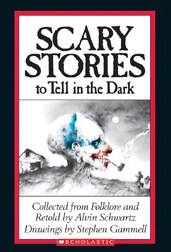
As fun as these tales are, this particular collection is best remembered for its original artwork by Stephen Gammell. For a sampling, simply search for the art online as its splattered all over the internet (my tri-sampling here is minimal in light of the numerous art for a 111-page book). It's great that in 1981 publishers were not too concerned over distributing such disturbing images to young readers, while the readers were excited and often terrified by them: accounts of nightmares or covering up certain pages can be found on some Goodreads reviews. At some point the modern HarperCollins did feel the need to tone down the volume and re-issued Alvin Schwartz's text with brand new, and entirely different (essentially sanitized), artwork by Brett Helquist.


The complete table of contents:

AAAAAAAAAAAH!
1. The Big Toe
2. The Walk
3. "What Do You Come for?"
4. Me Tie Dough-ty Walker!
5. A Man Who Lived in Leeds
6. Old Woman All Skin and Bone

He Heard Footsteps Coming Up the Cellar Stairs...
1. TheThing
2. Cold as Clay
3. The White Wolf
4. The Haunted House
5. The Guests

They Eat Your Eyes, They Eat Your Nose
1. The Hearse Song
2. The Girl Who Stood on a Grave
3. A New Horse
4. Alligators
5. Room for One More
6. The Wendigo
7. The Dead Man's Brains
8. "May I Carry Your Basket?"

Other Dangers
1. The Hook
2. The White Satin Evening Gown
3. High Beams
4. The Babysitter

AAAAAAAAAAAH!
1. The Viper
2. The Attic
3. The Slithery-Dee
4. Aaron Kelly's Bones
5. Wait Till Martin Comes
6. The Ghost with the Bloody Fingers


Friday, October 30, 2015

The Fiction Desk 8: New Ghost Stories II (2014)

Redman, Rob, editor, The Fiction Desk: New Ghost Stories II, 2014

The Fiction Desk: New Ghost Stories II at Goodreads
The Fiction Desk website

Overall Rating: 6/10


I have fallen behind in my reading of The Fiction Desk and other periodicals. Partly it's because I'm behind on all reviews, having been away, busy, and reading more contemporary fiction that I don't frequently review for this site. Partly it's because I haven't been reading periodicals as much lately, or short stories in general. Partly because my two and-a-half year-old is entertainment enough. And my reading lately has evolved toward picture books.

New Ghost Stories II includes eleven original short stories and a reprint of a medieval poem. Overall I did not enjoy it as much as previous issues, nor as much as their first ghost stories anthology, but there are some good tales included. Though many stories have a fantastical element, and those that don't have the suggestion of one, there aren't too many actual ghosts in the book. This of course is not a bad thing, since it offers a nice variety of subjects, from traditional ghosts to none at all, and some nice ambiguity in between.


Incomers by Amanda Mason     7/10
Emma and Jamie spend the New Year weekend at a port-side retreat where they've rented an old house. Soon Emma is troubled by feelings of a presence in the house, and of Jamie's seeming disinterest in her. The point of view is third person but limited to Emma, and we learn of her insecurities toward Jamie's bond with his former partner and of her feelings of inadequacy in relation to what are, essentially, Jamie's hobbies and interests. Meanwhile, through some acquaintances we discover the history of the house they are staying in, and of a certain scorned woman who once lived there.

"Incomers" is among the ambiguous ghost tales of the bunch. The existence of a ghost depends on the reader's interpretations, since there is no direct explanation offered. Personally I like the ambiguity, and my own rational leanings will conclude that the feelings of a ghost are the result of Emma's own heightened anxieties. Her suspicions that Jamie does not love her are founded on emotionally wrought, though likely accurate readings, evoke the sense of a ghost, and the eventual guilt for something clearly not her fault, despite her having secretly hoped for it. Ghost or no ghost this is among my favourites of the group.

Ms. Mason's other contribution to The Fiction Desk was also a ghost story and also quite good: "No Good Deeds" from the first ghost story collection.


The Bear Got Me by Matthew Licht     4/10
A government worker driving to a base in Alaska is chased by a ghost bear. Again closely limited to a single point of view, though here we have only one character and hence nothing external to interpret. The humour is not my thing and I rushed through the story as quickly as Garson rushed from that bear. Again, there is no evidence that the bear was there, ghostly or otherwise, and in the case of this story with its less than reliable narrator, I am left to believe it was a figment of the driver's overwrought imagination.

This is Licht's fourth appearance in The Fiction Desk, following "Dave Tough's Luck" (Various Authors), "Across the Kinderhook" (Crying Just Like Anybody) and "Washout" (New Ghost Stories).


Next to Godliness by Matt Plass     7/10
Strange occurrences in the home of a young couple lead them to suspect that their deceased little girl has returned home. Told through the father's point of view, it is the mother who wants to welcome the ghostly girl home, while the father is reticent. A strong story steeped in tragedy, well written and quite moving. Ghost or no ghost, the story's plot hinges on the possibility of a ghost and in that regard it is a ghost story.


The Table by Tamsin Hopkins     6/10
The death of the family matriarch reunites her husband and their three children. Told through one of the daughters' point of view, we learn that the mother had a vision of two girls seated perpetually at the titular table, a vision shared at one time by the children. A good and unique little read, it is also surprisingly touching, not just in its final moment, but with the notion of all we let go of as we grow up. "The Table" is most certainly a ghost story.


The Armies by Miha Mazzini     5/10 (Translated by Lenart Pogacnik)
A child's escapism from the unhealthy influence of his mother and grandmother's relationship. Not at all a ghost story since the visions are intentional figments of the boy's imagination, a form of escapism within the self. "The Armies" is, however, potentially more unsettling than many a tale of spectres, and can be included in the psychological horror category (if one were inclined to seek a seb-genre). This is Mazzini's second story for The Fiction Desk, following "I'm the One" from TFD4: Crying Just Like Anybody, and "In the Walls" from TFD6: New Ghost Stories.


The Time of Your Life by Lucinda Bromfield     5/10
After the sudden death of his father, a young lawyer inherits his father's position as well as his watch. The wearing of the watch leads to changes in our hero, and gives meaning to memories of his father's visits to a certain mysterious old man. The fantastical element is present, but not spectral, and though not a bad story it is somewhat lacking.


End of the Rope by Melanie Whipman     6/10
At school our young narrator is buddied up with the strange new girl in class, and the two outcasts soon become friends. Escapism and implications of abuse propel the narrative and the bond between the two girls. The title serves a dual purpose: escaping off the ground as well as from reality. The ending is reminiscent of some the original Twilight Zone stories of escapism. The ghost element depends once again on interpretation, as the narrator's vision at the end is not supported externally, and can hence be a creation of her own over-wrought imagination. Granted she is a trustworthy narrator, but recent knowledge and experience is helping shape her outlook on things.

According to her website, Melanie Whipman's first short story collection, titled Llama Sutra, is to be released later this year by Ink Tears Press, and based on this well written story, it's a collection to look out for.


Hell for Leather by Bernie Deehan     5/10
Technician Terry is called up to install a security system at a bar that is soon to re-open. The same bar that, in its initial incarnation, served as the launching pad for a tragic event in Terry's youth. "Hell for Leather" is a fairly standard ghost story and hence predictable. I don't mind the coincidence of Terry being the one to be called to the bar, but I am suspicious that an establishment that's about to have its grand opening orders a security system at the last minute. You'd think it would be one of the first things the owners would get organized, rather than leaving the place un-secure while the renovations and preparations are being done, especially when we learn the place is already fully stocked with booze.


Twice a Day with Water by Die Booth     5/10
In this one, loner druggie Bren hallucinates the existence of a "spirit" that enters his body whenever he consumes pretty much anything. An interesting idea with a strong ending, I just could not care for the character who is never quite fleshed out, but presented as an agoraphobic user and seeks sympathy from that fact alone. The ghost element is a figment in the mind of Bren, particularly in light of the fact that as she is presented, she would not be able to bake a cake or pour a glass of vodka. This is Booth's third appearance in The Fiction Desk.


Watching Kate & Gustav by Alice Adams     6/10
Trapped in the apartment in which she was murdered, a woman's ghost watches the new tenants and their gloomy cat, and attempts to reach out to them. A good story with an unfortunately flat ending. Something a great deal more tragic could have been achieved with the circumstances at hand, and while the implication of tragedy is there, it comes across as passive as its narrator. Despite this, I genuinely liked the narrator, our ghost, and new tenant Kate, and would have enjoyed reading more of their exploits.


In Yon Green Hill to Dwell by Jane Alexander     7/10
A woman is troubled by her husband's lethargy and the memory of his former lover. Well written with a strong ending, I was strangely not as engaged in this one as in some of the others. Alexander's story received the prize for best ghost story and despite my lack of connection with it, I agree with the decision. The story is not only well written, but its thematic elements are well presented. It was inspired by the Scottish traditional tale in verse, "Tam Lin," which is reprinted after the story.


Thursday, October 1, 2015

John Ball, In the Heat of the Night (1967)

Ball, John, In the Heat of the Night, NY: Harper & Row, 1965
______, In the Heat of the Night, NY: Bantam Books, July 1967
______, In the Heat of the Night, London: Pan Books [X711], 1967 (pictured right)
______, In the Heat of the Night, NY: Bantam Books [020], 5th printing (my edition, pictured below)

In the Heat of the Night at Goodreads
In the Heat of the Night at IBList

Rating: 6/10

For more Friday's Forgotten Books, please visit Patti Abbott's blog.


In the Heat of the Night is best known in that it helped generate a remarkable and memorable film. It's been years since I've seen the film, and having now read the novel I am inspired to re-watch it, but not before writing this review since I want to focus only on the book. Incidentally, the novel received the 1966 Edgar Award for Best First Novel, whereas the film received the Academy Award for Best Movie.

The small South Carolina town of Wells is faced with handling the murder of white Italian musician Maestro Mantoli, who was instrumental (pun intended) in organizing a large-scale music festival in the hopes of generating a tourist economy for the suffering region. The conductor's body is discover by deputy Sam Wood in the middle of the night, and in search of suspicious characters he picks up a well-dressed black man at a train station, who turns out to be Pasadena violent crimes investigator Virgil Tibbs. Tibbs is brought in on the case as a potential fall-guy so that the city council can save face over such a high profile investigation, should anything go wrong. Essentially, blame the unsolved crime on the incompetent black guy. Tibbs, however, proves to be highly intelligent and an excellent investigator.

Racial discrimination is certainly a major focus, as Tibbs, in the few days he spends on the investigation, faces various forms of racism. Some are extreme and stem from plain ignorance, while more complex forms of racism are explored via Sam Wood, a relatively positive character. Unlike the other inhabitants of Wells, with the exception of the northern and progressive Italians, Wood recognizes and quickly admires not only Tibbs's intelligence and training, but also his respectful demeanor. Throughout the investigation, the emotional and at times hard-headed Wood finds that his views on race are being challenged, that he has been conditioned to view certain people, black or Italian, through the society in which he was raised, rather by reason, and finds himself by the end of the novel not only admiring Tibbs, but in love with an Italian woman.

Another focus is an interesting situation with the Wells head of police, Chief Gillespie. It is made clear that Gillespie is incompetent and has been hired because of his inexperience. The town council can in this way control the police force and pressure the chief to do their bidding, since his post is not too secure, and since he does not have the respect of the rest of the force. Plot-wise this allows Tibbs to handle the investigation as he sees fit, since Gillespie's involvement becomes minimal. An intelligent and conscientious officer would have taken on the investigation rather than be impressed by an outsider, black or white.The adverse effect of this element, however, is unfortunate. As intelligently as Tibbs is presented, the fact that the law enforcement of Wells, particularly its chief, is less than average, undermines Tibbs's own efforts. Simply put, Tibbs would be truly extraodinary had he managed to solve a murder that baffled a competent police force.

The novel is written through a problematic point of view. The third person is limited to three characters for the most part, Tibbs, Gillespie and Wood, with minor awkward interference from others. Most of the point of view rests with the white men, however, so that Tibbs, the character we should be following, is relegated to the role of outsider. Since he is the outsider in the town, it is as though the readers should be identifying themselves with the racist locals rather than the progressive Californian. Of course Ball was focusing not only on a standard who-dun-it plot, so that point of view had to be stretched out. Wood's point of view in particular is required in illustrating how ridiculous it is to judge a person by their skin colour, and his coming to terms with his own prejudice is important to the novel and the genre. Moreover, by relegating Tibbs's investigation to second-tier focus, Ball is able to withhold evidence that Tibbs uncovers early on, and springing it at the reader at specific points in the text. On one end this gives the novel an artificial feel, while on another it increases drama and allows the mystery to maintain its weight against the book's important and inherent social commentary.

Though the investigation itself is quite interesting, the resolution is a little anti-climactic. Not because it is predictable (that it certainly isn't), but because it is so unremarkable. I was piecing together a council conspiracy which, admittedly, would have been an obvious suspect.

The love story sub-plot is unbelievable and poorly delivered. Aside from allowing Wood to fall in love with an Italian, it serves little purpose. Moreover, though author Ball does well in presenting non-white characters, he unfortunately fails in delivering positive, or even realistic female characters.

Interestingly, the N-word is used quite liberally in the novel, yet only in full by the less than likable councilmen, including the mayor, Gillespie's boss. Other, more positive characters, have the word on the tips of their tongues, such as deputy Sam Morton, who occasionally mutter the word's first syllable, as Ball, wanting these characters to be likable despite their views on race, prevents them from saying the despised word while still portraying them as locals of a deep-rooted racist community.


Friday, August 14, 2015

Midnight Fright: A Collection of Ghost Stories (1980)

uncredited, Midnight Fright: A Collection of Ghost Stories, Watermill Press, 1980
______, Midnight Fright: A Collection of Ghost Stories, Watermill Press, 1994

Midnight Fright at Goodreads
Midnight Fright at IBSFdb
Midnight Fright at IBList

Rating: 7/10

For more Forgotten Books, please visit Patti Abbott's blog.

This tiny anthology of five supernatural tales, specifically labeled "ghost stories," is essentially made up of tales widely available over the internet as well as across numerous print anthologies. Surprisingly re-printed in 1994, the anthology will likely never be printed again, as the internet has made most tales in this vein and in this period so readily available. The initial packaging of this five-some appears quite generic and nondescript, though I do like the simple cover (pictured), while the 1994 reprint is packaged as a set of tales for young adults, with an amusingly colourful cover by Mia Tavonatti. By packaging such a volume for a younger readership, the implication is that the stories would not frighten adults, and yet many of these tales have serious threads that only adults can appreciate. (Of course I'm generalizing.)

I mention that the stories are "labeled" as ghost stories because, if we are to examine each one of them individually, four of the five are not ghost stories at all. In fact, many nineteenth century and early twentieth century ghost stories are not actually ghost stories, including some popular tales consistently labeled and anthologized as such. The separation of fiction into genres, eventually associating stories with a certain "class" of readership, was a practice popularized in the early twentieth centuries (thereby H.G. Wells and R.L. Stevenson are considered literature, M.R. James is sometimes considered literature, while latter twentieth century authors of the supernatural are most often considered trash--another generalization). In more recent years the practice of classifying stories has increased drastically and the expansion of sub-genres has exploded to the point that contemporary readers have become obsessed with classifying fiction the way entomologists have been classifying insects. From a revisionist point of view, we can examine the stories collected in Midnight Fright in light of genre, and re-classify them in light of of contemporary approaches to genre. I will here examine the stories as ghost stories and in most cases de-classify them as such, and invite others to attempt to properly re-classify them. The benefit in such an exercise is to understand the development of genre in fiction, as well as to examine our changing perceptions of genre. More importantly, the author's own intention is clearer since often specific genres have adverse affect on the fiction itself, and as discussed below, in particular the Dickens's "The Signalman" and Gilman's "The Yellow Wallpaper" are vastly different if we were to view them as ghost stories rather than as what they actually are.

Of course this review is filled with spoilers. If you haven't already, please read the stories themselves. All are good and most are great, and they are individually a better read than my silly review.

On a side-note I will briefly look at the anthology itself. As a collection the story choices are for the most part good, assuming a young readership who hasn't yet encountered the classics and often anthologized stories by Dickens, Gilman and Maupassant. The layout and printing is unfortunately poorly done, so that the diary entries in "The Horla" are mashed together while space breaks are not always obvious.


The Signalman by Charles Dickens     5/10
First published in Mugby Junction, 1866

This excellent story by this excellent author remains powerful not for its final, climactic and revelatory moment, but for the real tragedy the situation embodies. A lonely signalman is visited by our wandering narrator who is curiously drawn to the man. After an awkward introduction, the two men strike up an acquaintance, and the signalman confides in the gentleman that an apparition that has visited him twice before a tragic event on the track, has once again appeared to him a few days past, indicating that another tragedy is about to strike.

The idea that the apparition is a ghost is inaccurate. If we are to accept that a ghost is the spirit of a deceased person that exists within the plane of the living, the figure seen by the signalman is not a ghost. Instead, the apparition is an astral projection in time; the image of a (living) train engineer in the future appearing to the signalman. There is no projection of place as the image appears exactly where the real engineer will appear at the end of the tale, and simply appears out of time. Built into the narrative is the idea that the signalman has a sensitive connection to the moment of his death, and it is not the engineer who attempts to warn him of his impending death, but he himself who is picking up this message. It is interesting that the story is titled "The Signalman" rather than "The Ghost," or "The Apparition," or pretty much anything else. The story is about the signalman more than it is about anything else, with Dickens's narrator focusing on character. Dickens's idea is that he is a signalman not only in occupation but in his innate ability to pick up this signal from the future.

Dickens's idea of a signal and the sensitive connection to the signalman's death is also shared with the narrator. This man, who we know little of and who appears to act primarily as a narrator-witness to the supernatural event, is drawn to the signalman without reason or motive. This is highlighted when he is unable to give a reason when the signalman requests one. The narrator is observant and rational, and attempts to reason with the signalman, offering up excuses as lame as it is all just coincidence, which neither of the men believe. The rational gentleman is toying a little with the signalman, trying to elevate his status and trying to lead him to believe in a rational explanation, when in reality he is trying to convince himself of reason, to explain being drawn to this spot and to this man from who knows where and across what distance.

Interestingly, a faithful and very good BBC adaptation of the story has a similar interpretation, and segments the different meetings between the two men by focusing on the wanderer as he lies in bed, unable to sleep, and clearly disturbed by not only the signalman's dilemma, but his own involvement in it. It is even hinted that he too received a spirited visit on the last night in his room. This version uses the sound of the bell and train as a conduit between the event and the wanderer: though he does not hear the bell while in the cabin with the signalman, the sounds do play out vividly as he is racing toward the track, fearing the worst, implying that a connection does exist.

Dickens makes it clear that the narrator has a connection but that the connection is not as strong as that of the signalman, and it is possible that the signalman's sensitive nature is extending to the narrator, so he is psychically reaching out toward the narrator or anyone else who might be passing by. Among the many nineteenth century notions that Dickens believed strongly in was mesmerism, and the idea of a kind of attraction between these two men is heightened by this fact, and also by the fact that mesmeric connections also exist in other works, notably The Mystery of Edwin Drood.


Man-Size in Marble by E. Nesbit     6/10
First published in Home Chimes, December 1887

A young, loving couple move into a lovely, strangely inexpensive home in a rural community outside London. They soon learn from their hired help that the house and the nearby church are cursed: On Halloween night of each year the two churchyard marble statues walk the grounds over to their very home, and should they encounter anyone on their journey, that person shall perish. Not a bad story as story's go, but highly predictable. Author Nesbit fills her stories with many standard supernatural tropes, such as including a rational witness to the events (a neighbour, also an outsider, and a doctor disbelieving in all this nonsense), and leaving physical evidence via a marble finger in the hand of the eventual victim.Not deftly handled as the reader wonders how such a frail woman can break off a marble finger that has survived so many generations, and our narrator proves himself to be an imbecile with the idiotic decisions he makes (returning to the churchyard with the doctor when he is convinced the stones have walked and his lover might be in danger).

As far this being a ghost story, it does not work as such. The marble figures come to life, or more accurately, become animated as part of an ancient curse. There is no indication that a ghost is involved, or that the figures themselves are in any way haunted. This is a supernatural story that involves a curse. The titular object in "The Monkey's Paw" is also cursed, and no one would suggest that paw is a ghost, even though it might give a slight curl when in the wisher's hand. Cursed objects are not ghosts, and instead are more akin to stories of witchcraft since some spell is involved, even there is no direct evidence of a witch.


The Yellow Wallpaper by Charlotte Perkins Gilman     9/10
First published in New England Magazine, January 1892

There is a reason "The Yellow Wallpaper" is among the most anthologized stories in both non-genre and genre publications: it is a powerful story, well written, that acts well as a suspense story as it does as social commentary. As sub-genre the story can be classified as psychological horror and not at all as a ghost story. In fact, claiming "The Yellow Wallpaper" to be a ghost story removed its social implications and hence the author's obvious point. If the shape behind the wallpaper exists outside of the narrator's mind, then it is that supernatural force that is driving her mad, rather than the incarceration by the rational individuals around her. The implication that society is incarcerating women, segregating them as ill and removing them from their function within society is weakened by the ghost theory. Our narrator does, near the beginning when describing the house they are spending the summer in, refer to it as being haunted, but she does so to indicate the impression she has received from the house's seclusion, and is not being literal. It is she who will, in a sense, haunt that house and haunt the nursery, her room she is essentially trapped in. The mysterious figure behind the wallpaper is undoubtedly stemmed from her overwrought mind, a projection of herself onto, or into, the wallpaper itself. Since she is unable to escape the barred room of the nursery, and her husband unwilling to leave that house even if just for the summer, it is the constraints of her mind that the woman has successfully escaped from. There is nothing in the text that in any way implies a ghost is present, and the powerful final moment, that creepy "creeping" scene, is powerful and horrific because there is no ghost.


The Cigarette Case by Oliver Onions     7/10
First published in The Weekly Tale-Teller, 13 August 1910

This story employs the all-too familiar setting of a narrator telling of a man who in turn is telling a ghost story, this time to the members of their club. The man recounts his experience visiting France with a friend many decades ago, when they encountered some ghosts with whom they visited. "The Cigarette Case" is the only genuine ghost story of the fivesome collected in the anthology. It is fairly standard in concept and approach, yet it is well written and entertaining. Like many ghost stories we are here given a witness who simultaneously corroborates the tale and yet does not: the friend was present at the time and yet is not in this story with the implication that he has since died. We are also given physical evidence of the ghost in the form of the cigarette case of the title.


The Horla by Guy de Maupassant (translator not credited)     8/10
First published in Gil Blas, 26 October 1886; first English translation published in Modern Ghosts, 1890

Maupassant's famous story is a diary narrative of a man losing his mind under the stress of being pursued by an invisible creature from Brazil. Not a ghost story at all, the creature is clearly an invisible Brazilian vampire (a sub-genre all of its own). The idea that the creature is a vampire is mentioned in the text itself, yet as a suggestion and not as fact. The creature is a kind of parasite, invisible and possibly humanoid in form. The invisibility can suggest a ghost and that our narrator's home has suddenly become haunted, yet the being is clearly alive, a living, thinking parasite, and is also mobile, not restricted to the house as standard ideas of haunted houses suggests. The creature closely resembles that of Ambrose Bierce's invisible creature from "The Damned Thing," a being whose colour is not visible to the human eye.


Friday, July 31, 2015

Marie Belloc Lowndes, The Lodger (1911)

Lowndes, Marie Belloc, The Lodger, McClure Magazine, January 1911
______, The Lodger, 1913
______, The Lodger, New York: Dell Books, 19 (my edition, pictured)

The Lodger at Goodreads
The Lodger at IBList

Rating: 8/10

For more of this week's Friday's Forgotten Books, please visit Evan Lewis's blog.


The literary myth surrounding Marie Belloc Lowndes's most famous work is that it stemmed from a dinner party conversation. Someone reported that they knew of a former cook and butler who temporarily housed the Whitechapel Murderer, today better known as Jack the Ripper. First published in 1911, just under a quarter of a century after the infamous crimes, Lowndes's novel reflects an interest in that particular scenario and hence does not focus primarily on its titular character. Instead, it focuses on the aging and struggling couple and their strained relationship more than it does on the crimes and the killer. This is to the novel's benefit, as the tense relationship does more to enhance the murders than would any amount of blood.

Moreover, the work acts as an interesting position on the actual crimes: it was written early enough to have avoided the modern Ripper canon, so that there are more murders attributed to the moniker. It also appeared at a time when censorship prohibited any kind of accurate description of the Ripper's brutal slayings. No dismembered corpses and displaced organs; just a little bit of blood.

It is no wonder that, though I read the novel as a teenager in the anthology of Jack the Ripper stories, Red Jack (Martin H. Greenberg, Charles G. Waugh & Frank D. McSherry, jr., eds, NY: DAW Books, 1988), I had absolutely no recollection of it. At that age I was seeking the thrills of suspense, violence and surprise endings, and probably wasn't even aware of the incredible tension generated by the protagonists: landlords Robert and Ellen Bunting. The Buntings are retired butler and cook, and in their retirement age are suffering from poverty, from years of repressed emotion, and from memories of past glory. The presence of this mysterious and eccentric lodger, Mr. Sleuth, who might be responsible for the recent spate of killings attributed to a serial killer known as the Avenger, acts as a kind of personification of the troubles between man and wife.

Lowndes's prose is gaslit: dark and hazy, tight and claustrophobic. Immediately the gloom is established, the room cozy yet in a "grimy" London neighbourhood, where the focus on our heroes is in light of their poverty. Effective too is the contrast between husband and wife: Mr. Bunting is "leaning back in a deep leather arm-chair," while Mrs. Bunting is "sitting up in an uncomfortable straight-backed chair." This contrast is important as it accurately delineates the characters, and might as well be describing how they are settled within their own skins. Whereas Mr. Bunting is mostly relaxed and easy-going, Mrs. Bunting is a ball of anxiety. It is she who first suspects that their Lodger might be the Avenger, and she clutches at this secret though it makes her incredibly tight and wound up, bordering on a nervous breakdown. Mr. Bunting only suspects their lodger fairly late in the narrative, and while he too becomes unbearably nervous, it is clear that his wife has the strongest sensibility and is better able to cope with the anxieties, though unfortunately she releases steam by snapping at her devoted ans sensitive husband.

Mrs. Bunting can come across as unlikeable in her extreme treatment of her easygoing husband, yet there is the understanding that this side of her is a result of the stresses of poverty, heightened by the suspicion she is housing a serial murderer. Most interesting in her characterization is an instinctive, irrational need in the early part of the text to defend her lodger. While part of this is denial that Mr. Sleuth is a killer, there is a side of her that feels compelled to protect the man. Having been servant and servient throughout her career, she harbours a sense of responsibility to the man whose basic household needs she is catering to. All this despite the guilt--and in this she is guilty--of allowing the Avenger to commit more murders. In protecting his identity she is an accomplice to the deaths that occur during his stay at her home. An unlikeable character who is accomplice to murder makes for a unique protagonist, and this heightens the novel both in interest and in complexity, a work well in advance and subtlety than Bret Easton Ellis's American Psycho (though in fairness the two are mostly incomparable).

Other characters are less dimensional. Mr. Bunting has some level of complexity, though this is primarily in light of his relationship with Ellen Bunting, for otherwise he has a fairly fixed personality to comply with his role in the novel. His niece and her lover, local policeman Joe Chandler, exist primarily to break the tensions of the story, to offer some light amid the gloom, and with their blossoming romance, some sense of a possible positive future. In addition, Chandler is required in order to share information with both the Buntings and the reader, to hypothesize and to increase certain elements of tension, such as the lodger's abhorrence of visitors to the house. The lodger himself, Mr. Sleuth, is a mysterious, anxious eccentric who is fairly stock, though it is his stockness within these qualities that makes him suit his role.

A novel for which much can be written and through several angles, and one I will certainly revisit.


free counters

As of 24 December 2015